
Insider threats are one of healthcare’s hardest security problems because the people causing the risk often already have access. In the article, I point to a simple fact: 39% of analyzed healthcare-sector breaches involved insiders, and the average healthcare breach cost reached $7.42 million. That means firewalls, MFA, and audit logs are not enough on their own.
Here’s the short version:
- I explain the three main insider threat types: malicious, negligent, and compromised users
- I show how insider misuse happens in daily clinical work, like snooping in charts, sending PHI to the wrong place, or keeping access after offboarding
- I break down why standard controls miss slow, low-volume misuse
- I show how behavioral analytics/UEBA spots activity that does not match a user’s role, shift, peer group, or patient relationship
- I cover key healthcare use cases, such as off-shift chart access, VIP record snooping, cross-department viewing, odd printing/export activity, and strange remote access
- I end with how to put this into a formal risk and response process across Security, Privacy, Compliance, HR, Legal, and Clinical Leadership
If I had to sum it up in one line, it would be this: the main question is no longer just “Does this person have access?” but “Does this use of access make sense?”
A quick view:
| Area | What I cover |
|---|---|
| The problem | Insider misuse often looks normal at first |
| Why healthcare is at risk | Fast care, shared devices, broad access, third-party vendor risks |
| Where controls fall short | Static rules miss context and slow behavior drift |
| The fix | Behavioral analytics learns normal patterns and flags outliers |
| What to watch for | Off-shift access, snooping, export spikes, remote misuse |
| What teams need | Clear triage, case review, and documented response steps |
So if you want the core takeaway before reading the full piece, here it is: healthcare needs user-level visibility, not just perimeter security, to find insider risk early and respond with facts.
The Healthcare Insider Threat Problem: Behaviors, Impacts, and Compliance Pressure
Common Insider Threat Scenarios in Clinical Settings
The risk usually starts in everyday clinical work, not in some obvious attack.
In healthcare, insider misuse often begins with normal access. A billing contractor uses valid EMR credentials to look through patient records over several months - names, Social Security numbers, and insurance data - then files fraudulent Medicare claims. On the surface, each access event looks allowed by the system. The pattern only comes into view after the incident, when investigators piece it together.
The same thing can happen in other routine settings. A registration clerk runs off-the-books searches on local celebrities or athletes and sells demographic and insurance data to an identity theft ring. A nurse sends a discharge summary to the wrong address because autocomplete picks a personal Gmail account instead of the patient's.
Other common cases show how fast bad habits can become normal in a busy clinic:
- Mass printing or exporting PHI before an employee leaves for a new job
- Using consumer messaging apps to send wound photos or lab results because the approved secure messaging tool is too slow
- Saving PHI on a personal laptop, tablet, or USB drive that is later lost or stolen
In fast-moving clinical environments, these shortcuts can slip into daily practice.
And when they come to light, the harm goes far beyond one record.
Business and Regulatory Impact in the United States
When insider incidents surface, the enterprise risks and legal fallout can be severe. Under the HIPAA Privacy and Security Rule, covered entities and business associates must protect PHI from unauthorized access, use, and disclosure. OCR reviews access controls, audit logs, training, and risk analysis.
Recent OCR actions show that lost devices and improper EMR access can lead to large settlements and corrective action plans. In May 2025, OCR announced an $800,000 settlement involving a former nonclinical employee who kept EMR access and improperly viewed and shared PHI[2].
The damage doesn't stop with penalties. Organizations may also face breach notification duties, state attorney general actions, class-action lawsuits, and major incident response and remediation costs. Patient trust can take a hit. Clinic operations can slow down or stall. Costs can climb as teams work through cleanup, legal review, and follow-up.
Why Insider Threats Persist Despite Existing Controls
The hard part is that many existing tools were not built to spot behavioral drift.
Role-based access in EMR systems has to be broad enough to support care delivery. That sounds fine in theory, but in practice it often gives users access to far more PHI than their day-to-day work calls for. Training helps people know the rules, but knowledge and behavior are not the same thing, especially when staff are tired, rushed, or checked out.
Audit logs are also often reviewed only after a complaint or an OCR inquiry, not on a steady basis across the organization. Older monitoring tools tend to depend on fixed thresholds, like a set number of records exported per hour. That can miss the quieter forms of misuse. A nurse who views one extra unit's charts each week may never trip a volume alert. Neither will a contractor whose access was never shut off after an assignment ended.
Each of these examples points to the same issue: static controls miss behavior that shifts slowly over time.
The result is compliance on paper without steady behavioral visibility. Those blind spots are exactly what behavioral analytics is built to address.
sbb-itb-535baee
User and Entity Behavior Analytics (UEBA): AI-Powered Cybersecurity & Threat Detection
Where Standard Insider Threat Controls Fall Short in Healthcare
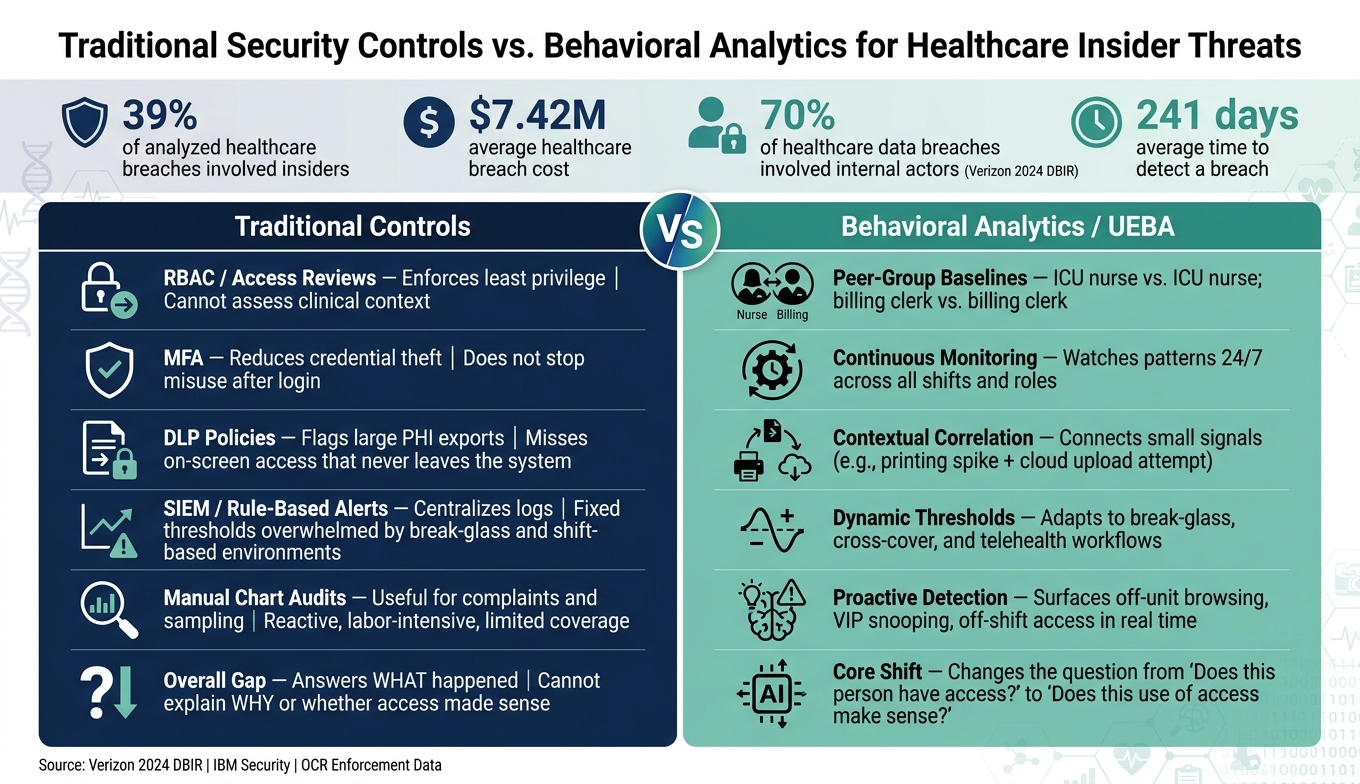
Traditional Security Controls vs. Behavioral Analytics for Healthcare Insider Threats
What Conventional Controls Do Well and Where They Miss
RBAC, MFA, DLP, SIEM, and access reviews do an important job: they control and track access. But they don't explain intent or whether access made sense in a clinical moment.
An EHR log can tell you what happened. It usually can't tell you why it happened. And when misuse happens in small amounts instead of one big data grab, rule-based detection often lets it slip by. That's the core problem. Insider threat detection in healthcare needs behavioral context, not access control alone.
This isn't just a theory. According to the Verizon 2024 Data Breach Investigations Report, 70% of healthcare data breaches involved internal actors, and privilege misuse climbed to the second-leading breach pattern.[5][6] IBM data cited in healthcare SIEM research suggests many organizations don't find breaches until about 241 days after initial access.[4]
Clinical Workflow Challenges That Weaken Static Monitoring
Healthcare runs all day, every day. Because of that, static rules often struggle with normal clinical exceptions. Break-glass access, shift changes, cross-covering staff, and shared workstations can all look suspicious to a rule engine even when they're part of routine care.
In trauma care, for example, repeated break-glass access is normal. A rule-based system may flag it again and again until alerts turn into noise.[8] In healthcare, the same action can mean proper care in one case and misuse in another. Context makes the difference.
Shared workstations add another layer of trouble. If a nursing station stays logged in under one account and several staff members use it back-to-back, the audit trail ties everything to one user. That makes it hard to know who actually opened the chart.
This is exactly where behavioral analytics has an edge over static rules. Instead of treating every odd-looking event the same way, it looks at patterns around the event.
Traditional Controls vs. Behavioral Analytics: A Comparison
The table below shows how standard controls and behavioral analytics handle insider threat detection in the areas where healthcare teams often face the most risk.
| Detection Approach | Strengths | Limitations | Healthcare-Specific Implication |
|---|---|---|---|
| RBAC / Access Reviews | Enforces least privilege; catches role drift and lingering access | Cannot assess clinical context | User may access charts with no active care relationship |
| MFA | Reduces credential theft risk on remote and privileged systems | Does not stop misuse after login | Compromised account can browse PHI after MFA is satisfied |
| DLP Policies | Flags or blocks large PHI exports via email, web, or print | Misses on-screen access that never leaves the system | Staff can review PHI without triggering an export event |
| SIEM / Rule-Based Alerts | Centralizes logs; catches obvious anomalies | Fixed thresholds create false positives in shift-based, break-glass environments | Emergency overrides and cross-covering staff overwhelm static rules |
| Manual Chart Audits | Useful for complaints, high-profile patients, and sampling | Reactive, labor-intensive, limited coverage | Quiet snooping may never get reviewed |
| Behavioral Analytics | Learns user and peer-group baselines; correlates signals in context | Requires tuning, integration, and ongoing governance | Surfaces off-unit chart browsing with no associated orders |
Behavioral analytics fills this gap by looking at activity in context instead of treating each access event as an isolated log entry.
Behavioral Analytics as a Solution for Insider Threat Detection
How Behavioral Analytics Works in Healthcare Environments
Behavioral analytics, often set up as User and Entity Behavior Analytics (UEBA), works by learning what normal looks like for each person, device, and application in your environment. Then it flags meaningful activity that falls outside that baseline.
The platform pulls in EHR and clinical application audit logs, IAM/SSO activity, VPN and remote access records, endpoint telemetry, badge access, DLP events, and medical device/IoMT logs. It then ties each event to a verified identity, along with role, department, shift, and employment status context.[1][14][17][22][25]
From there, it builds peer groups. An ICU nurse is measured against other ICU nurses working similar shifts. A billing clerk is compared with other billing staff, not ED physicians. That distinction matters. Activity that looks suspicious for one role may be routine for another. An ED physician opening hundreds of records in a shift may be normal. The same volume from a receptionist is not.[1][15][19]
The baseline learning period usually lasts 30 to 60 days. That gives the system enough time to account for shift rotations, on-call coverage, and telehealth workflows.[18][19][20][21] Once those baselines settle, the engine scores deviations on the fly. It weighs factors such as PHI sensitivity, system criticality, and whether several small warning signs are showing up together.
Key Use Cases for PHI and Clinical System Monitoring
Behavioral analytics does its best work when it finds patterns that a single rule would never catch. Once baselines are in place, the most useful alerts tend to come from the kinds of activity that rule-based monitoring misses.
High-value healthcare use cases include:
- Off-shift chart access - a clinician's account accessing patient records after the badge shows they left the building[11][3]
- VIP or high-profile patient snooping - access by staff with no documented care relationship to a high-profile patient's record
- Cross-department record viewing - a staff member in orthopedics repeatedly pulling behavioral health or oncology charts without documented clinical necessity[1][9][12]
- Abnormal printing or export behavior - sudden spikes in PHI report printing, bulk PDF exports, or data transfers to removable media[1][10][13]
- Suspicious prescription system use - atypical medication orders or overrides by users whose role does not normally touch prescribing workflows, which can indicate drug diversion[11][16]
- Anomalous remote access - excessive or atypical VPN sessions from new devices or locations outside normal shift patterns, especially from third-party vendor accounts[1][13]
What makes this work isn't one alert by itself. It's the way the system connects small signals that look harmless on their own. A billing clerk printing full clinical records, plus a DLP alert showing an attempted upload to consumer cloud storage, paints a very different picture than either event alone.
These alerts only matter if they get to the right team fast, with enough detail to act. Behavioral analytics can spot misuse sooner than manual audits because it watches patterns all the time.
Deployment Considerations: Tuning, Privacy, and Response Workflows
Detection only cuts risk when it feeds a clear response process.
Start with a readiness assessment. Make sure key systems such as EHR, IAM/SSO, VPN, endpoint, DLP, badge, and IoMT are logging at the right level, and confirm that audit trails line up with HIPAA technical safeguard expectations. After that, bring those sources together and normalize them, mapping each event to a verified identity with role and department metadata.
During the baseline period, the system takes in events and builds profiles without heavy alerting.[20][21] Privacy and security teams should watch early patterns during this window so they can understand normal variation, especially around shift rotations, on-call coverage, and telehealth workflows, before tuning thresholds. Then the next step is role-based alert weighting. What looks odd for a pharmacist will not match what looks odd for an HIM staff member or billing clerk.
On the governance side, behavioral analytics should feed straight into current incident response and case management workflows. High-risk alerts need to go to the right stakeholders, including Security Operations, the Privacy Office, Compliance, HR, and Clinical Informatics, with enough context for fast triage. In plain terms, an alert should do more than say unusual access. It should show what changed, how that compares with peer norms, which PHI categories were involved, and whether related alerts already exist.[1]
From a regulatory angle, this lines up with NIST controls for access, auditability, incident response, and risk assessment.[7][3][26]
Workforce transparency matters too. Staff should be told, through policy acknowledgments and training, that system access is monitored. The message should center on patient protection and regulatory duty, not surveillance. Access to behavioral analytics dashboards should be tightly limited by role, and any action that could affect employment status should involve HR and legal. The program should be framed as a patient-safety control, not employee surveillance.[17][23][24]
Putting Behavioral Analytics to Work Within a Healthcare Risk Management Program
Cross-Functional Governance for Insider Threat Review and Response
Behavioral analytics helps ONLY when alerts move into a formal insider-threat review process. A detection tool by itself isn’t enough. You need a review model that people follow every time.
Build a cross-functional insider-threat working group that includes Security, Privacy, Compliance, HR, Legal, and Clinical Leadership. Security handles the first alert triage. Then the other teams weigh in on PHI exposure, workforce impact, legal risk, and clinical context.
Every high-risk alert should move through technical triage first, then cross-functional review before any employment or licensure action. That step matters. In healthcare, the same behavior can look very different depending on the patient, the shift, and the care setting.
Document each decision with a structured case template. The template should capture:
- The risk scenario
- The clinical context
- Findings on intent
- Corrective actions taken
Use written response tiers tied to behavior and intent. Then audit decisions on a regular basis to check for consistency across roles and departments. If two similar cases get two different outcomes, that’s a problem worth fixing.
Track a small set of metrics so the process stays grounded in facts:
- Time to triage
- Time to resolution
- True-positive rate
- False-positive rate
- Confirmed cases per quarter
How Censinet Supports Healthcare Cyber Risk Management
Once alerts are validated, they need to flow into enterprise risk management. Censinet RiskOps™ can map behavioral alerts to enterprise and third-party risk records, rank high-PHI systems, and track remediation.
Conclusion: Better Visibility and Faster Response Reduce Insider Risk
Insider threats persist in healthcare because authorized access is hard to govern in fast-moving clinical settings. Behavioral analytics helps close that gap by shifting the question from “does this person have access?” to “is this person using access the way their role, shift, and patient relationships would predict?”
That shift leads to faster, better-grounded decisions. Behavioral analytics lowers insider risk only when detection is paired with clear governance, measurable response, and continuous tuning.
FAQs
What is UEBA in healthcare?
User and Entity Behavior Analytics (UEBA) is a cybersecurity method that uses machine learning and deep learning to map out what “normal” looks like for users and entities across a healthcare network.
Those entities can include medical devices, applications, and servers.
From there, UEBA keeps watching for behavior that falls outside that normal pattern. That can point to insider threats, compromised accounts, or more advanced attacks. It also uses context to assign risk scores, which helps security teams focus on the threats that matter most and cut down on false positives.
Why do insider threats bypass standard controls?
Insider threats often slip past standard security controls because many older tools depend on fixed, signature-based rules that look for known patterns.
That creates a big blind spot. These systems have a hard time separating malicious intent from normal activity carried out by authorized users. If someone is using valid credentials and trusted tools, they can blend in with everyday work.
As a result, actions like unauthorized access or mass data exports can be much harder to spot.
How can hospitals reduce insider threat risk?
Hospitals can cut insider threat risk with a layered approach. One useful step is behavioral analytics, which sets a baseline for normal user and device activity, then flags odd behavior like off-hours access, bulk downloads, or someone looking at records outside their department.
They should also enforce least-privilege access, require multi-factor authentication, keep tamper-evident audit logs, automate response actions, conduct regular access reviews, and back up these controls with staff training.
