
If a telehealth issue touches ePHI, the HIPAA clock may already be running. In telehealth, one missed link, one stolen device, one bad login, or one vendor delay can turn a routine security event into a breach review with a 60-day notice deadline.
Here’s the short version:
- I’d treat every telehealth security event as an incident first
- I’d separate incident from breach early, with a written four-factor HIPAA risk assessment
- I’d make sure logs cover video, portal, EHR, IAM, cloud storage, APIs, and devices
- I’d assign clear owners across security, privacy, legal, clinical, and telehealth teams
- I’d lock down vendor notice terms in the BAA, instead of waiting up to 60 days
- I’d keep one record for vendors, PHI flows, contracts, incidents, evidence, and deadlines
That’s the core message of this article. It explains that telehealth response is not just about restoring video visits. It’s about deciding fast whether PHI was involved, preserving proof, limiting patient impact, and keeping enough written support in case OCR asks questions later.
A few points stand out:
- HIPAA treats a security incident broadly: failed attempts, access events, outages, data exposure, and system interference may all count
- Not every incident is a breach, but every possible breach starts as an incident
- Business associates can slow everything down, which is why contract terms and vendor contacts matter so much —often requiring specific third-party risk assessment questions to identify gaps.
- Weak asset lists, poor audit trails, and fuzzy ownership often do more damage than the initial event
- For breaches affecting 500+ people, notice may go to individuals, HHS, and media
- For breaches under 500 people, individuals still must be told within 60 days of discovery
| Topic | What matters most |
|---|---|
| Incident vs. breach | Incidents must be logged and reviewed; breaches trigger notice duties |
| Time pressure | The 60-day period starts at discovery, not when the team feels done |
| Telehealth risk points | Video tools, portals, chat, recordings, APIs, cloud storage, devices, vendors |
| Main control areas | Logging, ownership, intake forms, evidence, BAAs, fallback care plans |
If I had to boil the article down to one line, it would be this: telehealth incident response needs a clear HIPAA workflow before anything goes wrong.
HIPAA at Home | Securing ePHI in a Remote and Telehealth World | Webinar on HIPAA Compliance
sbb-itb-535baee
Where Telehealth Incident Response Falls Short of HIPAA Requirements
Most telehealth problems don't come from one big miss. They come from smaller issues stacking up: missing inventories, split-up logs, fuzzy ownership, and weak vendor terms. Put them together, and incident scoping gets slower, breach analysis gets harder, and notification timelines get tighter. That’s why telehealth teams need a defined HIPAA response workflow, not last-minute troubleshooting.
Gaps in Telehealth Asset Visibility, PHI Flows, and Audit Logs
Telehealth setups often grow fast and in pieces. A health system may be running an EHR-embedded video tool, a standalone video platform, AI transcription, and RPM, but still lack a single inventory or risk register.[2] When something goes wrong, the security team may not even know where to start. Which systems have the right logs? Which PHI flows need to be traced?
The HIPAA Security Rule requires organizations to record and examine activity in information systems that contain or use ePHI.[1][6] That gets tough when telehealth platforms leave out patient IDs, user roles, and actions like screen sharing, recording, or file export.[10] If a stolen provider account joins a visit, investigators may be unable to tell whether PHI was only viewed or actually downloaded. And when that answer is missing, the safest call is often to treat it as a breach.
Undocumented EHR APIs add another problem. If links between telehealth platforms and the EHR are only partly logged, teams can't follow PHI across systems after an incident.[8][10] OCR expects organizations to quickly identify every system that may hold affected ePHI and produce the related audit trails.[3][8] Missing assets and siloed logs make that job a lot harder.
Unclear Roles, Inconsistent Risk Assessments, and Weak Documentation
When a telehealth incident hits, several teams usually jump in at once. IT wants service back online. The Privacy Officer is waiting to confirm whether PHI was exposed. Clinical operations is trying to reschedule patients. Legal is watching the deadline. Without one clear incident owner, the four-factor review and notification process can stall.[5][9]
HIPAA requires covered entities to name responsible officials and keep written policies for handling incidents and breaches.[1][7] But many telehealth programs haven't tied those duties to telehealth-specific events. So breach-versus-non-breach decisions may happen informally, in email threads or quick verbal discussions, without steady criteria or written sign-off.
That creates a paper trail problem. In an OCR review, regulators look for named roles, written procedures, and proof that the organization followed its own process.[4][7] If that record is thin, it can point to a governance problem even when the technical response itself was done well.
Vendor Reporting Delays and BAA Gaps
Telehealth vendors are business associates, so their reporting speed has a direct effect on whether a covered entity can meet HIPAA notice deadlines. Under 45 C.F.R. § 164.410, business associates must notify covered entities of a breach without unreasonable delay and no later than 60 calendar days after discovery.[11][12][13] Many BAAs stop at that outer limit and leave out key reporting details, such as what data must be shared, how it should be sent, and how fast initial notice should happen.[14]
That creates a nasty bottleneck. If a vendor waits too long, the covered entity has less time to finish breach analysis, draft notifications, and file with HHS.
Compliance experts often suggest much shorter contract windows, such as 10 business days, in BAAs to avoid that squeeze.[12][14] The next section turns these gaps into a HIPAA-aligned response process.
A HIPAA-Aligned Framework for Telehealth Incident Response
You can close these gaps with one telehealth incident playbook that ties HIPAA duties to NIST response steps. In plain terms, the framework below fixes the visibility, ownership, and vendor-reporting problems described above.
Map the Incident Lifecycle to HIPAA and NIST Response Steps
NIST SP 800-61 organizes incident response into four phases: Preparation; Detection and Analysis; Containment, Eradication, and Recovery; and Post-Incident Activity. Each phase lines up with HIPAA Security Rule requirements under 45 C.F.R. §164.308(a)(6), which says covered entities must identify and respond to suspected or known security incidents, reduce harmful effects, and document incidents and their outcomes.
| NIST Phase | HIPAA Obligation | Telehealth-Specific Action |
|---|---|---|
| Preparation | Define incident policies; assign roles | Define thresholds for telehealth security events versus breaches, such as failed logins to a virtual visit platform versus confirmed unauthorized access to visit recordings |
| Detection & Analysis | Monitor ePHI systems; initiate four-factor assessment | Check authentication failures, session anomalies, and centralized logs across the telehealth platform, EHR, identity provider, and endpoint devices |
| Containment, Eradication & Recovery | Mitigate harmful effects; restore systems safely | Lock accounts, revoke tokens, terminate sessions, isolate devices, reschedule visits, and validate systems before resuming care |
| Post-Incident Activity | Document outcomes; update policies | Run lessons-learned reviews and update telehealth-specific response procedures |
Once that workflow is in place, each step needs a clear owner. If nobody owns a task, it tends to drift.
Immediate containment actions - account lockouts, forced password resets, session termination, and device isolation - also need to be weighed against clinical continuity. For example, if the platform has to go offline, teams should move to a preplanned fallback such as telephone consults.
Define Governance, Ownership, and Evidence Requirements for Telehealth
A clear governance model helps stop coordination problems before they start. At a minimum, two roles need direct ownership:
- An Incident Response Coordinator who manages the NIST lifecycle, keeps the incident register up to date, and makes sure documentation is complete
- A Telehealth Program Lead who handles clinical workflow impacts, patient communication, and care continuity decisions
Escalation should follow a severity-based matrix that looks at PHI sensitivity, patient impact, and regulatory enterprise risk. High-severity events, such as suspected account takeover or data exfiltration, need immediate escalation. Lower-severity events can follow the standard same-day path.
Privacy Officer review should be required before closing any breach assessment. Security Officer approval should also be required before containment actions that affect telehealth availability. That may sound strict, but it helps avoid two common failures at once: rushed decisions and weak documentation.
On the documentation side, HIPAA record-keeping rules mean every incident needs a durable paper trail. That includes incident tickets, audit log extracts from the telehealth platform, EHR access logs, identity provider records, decision logs with written breach determinations, notification drafts with timestamps, remediation records, and post-incident reviews. OCR audits often ask for more than breach logs. They may also request evidence of incidents that were ultimately deemed non-breaches, along with the reasoning behind that call.
Embed HIPAA Breach Analysis into Every Telehealth Event
The simplest way to make breach analysis consistent is to build the HIPAA four-factor risk assessment straight into the incident intake template. That way, every telehealth event - even one that looks minor at first - starts with the right facts.
The intake form should require four things: the nature and extent of PHI involved (data elements, volume, sensitivity, especially for mental health, substance use, or reproductive health records); the identity of the unauthorized person and whether they are a covered entity, business associate, workforce member, known patient, or external threat actor; whether PHI was actually acquired or viewed, backed by audit log evidence; and what mitigation steps reduced the risk, such as account lockouts, remote wipe, or confirmed deletion by the recipient.
Here’s a concrete example: a scheduler sends a telehealth video link to the wrong patient. The intake form records which PHI was in the invite, whether the recipient opened it, and whether deletion was confirmed. The Privacy Officer then records a low-probability determination because no one joined the session and the recipient confirmed deletion.
Use branching logic in the intake form so the process doesn’t depend on memory. If the incident type is "wrong patient invited to telehealth visit" or "telehealth link misdirected", the form should automatically prompt for more PHI details and require Privacy Officer review before the ticket can be closed. That makes breach analysis repeatable and auditable.
The next step is to centralize the vendor and incident data that feeds this workflow. This centralization is a core component of effective third-party risk management in healthcare.
How to Run Compliant Incident Response Across the Telehealth Lifecycle
HIPAA Telehealth Incident Response: 60-Day Breach Notification Workflow
The next step is execution: contain the event, preserve evidence, and decide breach status without losing time. Once governance and intake are in place, incident response has to move from containment to documented breach analysis fast enough to satisfy OCR.
Detection, Triage, and Containment for Telehealth Systems
Good detection starts with a simple point: know which systems carry the most PHI risk. Your logging baseline should cover identity and access management (IAM), remote access/VPN, virtual visit platforms, patient portals and secure messaging, EHR integrations, cloud storage, and APIs used for telehealth delivery. For each system, logs should capture at minimum:
- user ID
- patient or resource ID
- timestamp
- device and IP
- MFA result
- action and result
- session start and stop
- failed access attempts, including session join and leave events, recording start and stop, file-share actions, and message send/receive details: sender, recipient, channel, metadata, not message content [10][16][17]
Test that baseline every quarter so your logs are complete before an OCR review asks for them.
When a suspected compromise appears, do an active-visit check before making any lockout call. Confirm whether an active or near-term virtual visit is scheduled. The goal is simple: protect care continuity while still limiting access to the risky function. In many cases, temporary restrictions make more sense than a full shutdown. That can mean forcing a password reset, requiring MFA re-enrollment, or temporarily restricting high-risk functions like bulk export or recording download. Use full lockout only for confirmed destructive activity.
Each playbook should spell out severity levels, on-call roles, and a max triage time target. That usually includes IR, privacy, telehealth operations, and a clinical lead. For suspected account compromise, a target of 30–60 minutes keeps teams moving.
Pre-set containment actions also matter because no one does their best thinking in the middle of chaos. For a compromised clinician or patient account, force active session logoff, require a password reset, and enforce MFA enrollment. For a lost or stolen device, trigger remote lock and wipe, revoke device certificates and MDM enrollment, and invalidate stored sessions and tokens across connected apps. Whether full-disk encryption and MDM were active at the time of loss will heavily shape the HIPAA risk assessment that follows. For an unauthorized or exposed recording, revoke access in the telehealth platform and cloud storage, remove shared links, and determine whether the recording was downloaded or re-shared before access was cut off.
Every containment action should include an evidence capture checkpoint: screenshots, log exports, and a timeline. That material should feed straight into the four-factor breach assessment [20][21]. Once containment begins, move the case into the formal breach-assessment clock right away.
Breach Assessment and Notification Workflows Under the 60-Day Rule
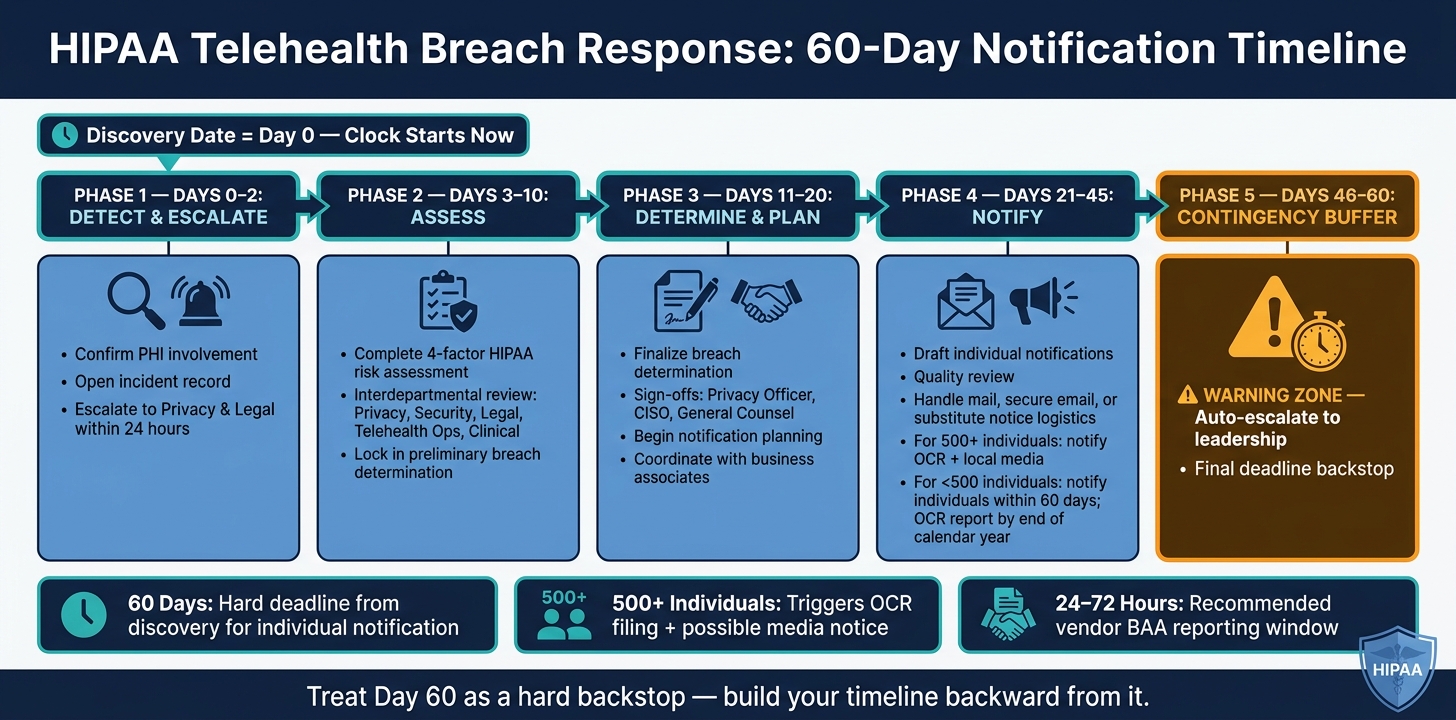
Treat day 60 as a hard backstop and build your review timeline backward from it. On paper, 60 days can sound generous. In practice, it vanishes once you account for investigation, legal review, drafting, address validation, and mailing logistics.
A workable structure looks like this:
- Days 0–2: confirm PHI involvement, open an incident record, and escalate to privacy and legal within 24 hours for any suspected PHI exposure.
- Days 3–10: complete the four-factor HIPAA risk assessment and hold an interdepartmental review with privacy, security, legal, telehealth operations, and clinical leadership if needed to lock in a preliminary breach determination.
- Days 11–20: finalize the determination, get sign-offs from the Privacy Officer, CISO, and general counsel, and start notification planning, including coordination with any business associates whose systems were involved.
- Days 21–45: handle drafting, quality review, and logistics for mail, secure email, or substitute notice.
- Days 46–60: use this as a contingency window. If a case gets this far, leadership escalation should happen automatically.
For breaches affecting 500 or more individuals, notifications go to affected individuals, OCR, and in some cases local media outlets [11][19]. For breaches affecting fewer than 500 individuals, individual notifications are still due within 60 days of discovery, but the OCR report can be submitted within 60 days after the end of the calendar year [18][20].
Automated ticketing with SLA reminders and a visible status dashboard, tracked against the 60-day outer limit, helps keep telehealth incidents from quietly drifting past key milestones.
Response Actions by Telehealth Incident Type
Use the incident-type matrix below to standardize containment and documentation. Notification duties in every case depend on the breach assessment outcome. That same logic applies across all rows.
Table: Telehealth incident types and required HIPAA response actions
| Incident Type | Containment Steps | Risk Assessment Need | Required Documentation |
|---|---|---|---|
| Lost or stolen device | Remote lock/wipe; revoke MDM enrollment; invalidate sessions and tokens | Four-factor assessment; encryption and MDM status are key inputs | Device inventory, encryption status, MDM logs, wipe confirmation |
| Account takeover (clinician or patient) | Force session logoff; password reset; MFA enforcement | Four-factor assessment; review what PHI was accessible during the unauthorized session | Auth logs, session records, access history, IR timeline |
| Exposed or unauthorized recording | Revoke access; remove shared links; disable public sharing | Determine whether the recording was downloaded or re-shared and whether PHI was visible or audible | Platform access logs, download history, sharing configuration at time of incident |
| Misdirected patient message or visit summary | Halt further outbound communications to the incorrect destination; correct contact details in the EHR/portal | Assess PHI sensitivity and volume; evaluate mitigation efforts | Message metadata, correction records, recipient deletion confirmation (if obtained) |
| Unauthorized portal access | Terminate session; reset credentials; audit recent portal activity | Assess what records were viewed or downloaded | Portal audit logs, session details, access scope |
| Vendor- or platform-related incident | Engage vendor IR contacts; preserve logs; coordinate impact review | Assess whether PHI was involved and what records show about access or viewing | Vendor incident report, BAA notification timeline, internal impact assessment |
When a telehealth vendor is involved, BAAs should require vendors to report potential PHI incidents within 24–72 hours of discovery. They should also provide incident reports with event timelines, affected services, whether PHI was involved, and log evidence showing whether PHI was accessed or viewed. Vendor notice needs to support your own breach determination before the 60-day clock runs out. For large platform incidents, ask for a customer-specific incident summary. Do not rely on a generic status page.
Using Centralized Risk Management to Strengthen Telehealth Incident Response
Centralize Telehealth Vendor, BAA, and Incident Data
The fix is simple: create one source of truth for vendors, BAAs, PHI flows, and incidents.
Keep vendor, BAA, and incident data in one system of record. That system should track services, hosting, PHI flows, integration points, notification timelines, subcontractor obligations, escalation clauses, prior incidents, control gaps, and open remediation tasks. When all of that sits in one place, responders can answer ownership and notification questions right away instead of hunting through emails, spreadsheets, and contract folders.
That matters because responders need facts fast. A central record helps them scope the event and start the four-factor assessment without wasting time searching across systems.
Business-associate incidents make this even more urgent. Roughly 30% of large healthcare breaches happen at business associates, and healthcare sees more third-party data breaches than any other sector [15][26]. If a cloud-hosted telehealth platform reports suspected unauthorized access, a centralized inventory can surface the platform’s PHI types, current risk rating, BAA notification windows, and the right contacts - CISO, Privacy Officer, and vendor security lead - right away. No digging. No guesswork. That speed helps keep the four-factor breach assessment moving and makes the 60-day notification window far less painful to manage.
How Censinet Supports HIPAA-Aligned Telehealth Incident Response
A healthcare-focused risk platform can put that central model into day-to-day use. Censinet RiskOps™ is built for healthcare cybersecurity and risk management, which makes it a strong fit for the telehealth incident response issues covered in this article.
The platform supports structured third-party risk assessments with healthcare-specific questionnaires. That lets organizations review telehealth vendors before an incident happens, including areas like:
- Encryption practices
- Access controls
- Incident response procedures
- Certifications
During an incident, RiskOps™ brings vendor profiles, BAA terms, PHI mappings, control gaps, and remediation tasks into one workflow. Censinet AI™ can synthesize questionnaires, audit reports, and prior incidents to help speed four-factor assessment review. In plain English, it helps teams get to the evidence faster and keep a cleaner record for HIPAA review.
Conclusion: Core Controls That Reduce Telehealth HIPAA Exposure
With that groundwork in place, telehealth HIPAA exposure drops when teams apply a small set of core controls the same way every time.
Classify events the right way - incident versus breach - before the four-factor assessment starts. Keep full visibility across telehealth platforms, cloud services, EHR integrations, backups, and logs so detection gaps don’t turn into discovery gaps during an OCR review. Set clear governance so privacy, security, legal, and clinical leaders know their roles before an incident hits. Use standard four-factor assessment templates so decisions stay consistent and defensible no matter who works the case. Tighten vendor reporting through BAAs with clear notification rules and defined evidence deliverables.
These are the controls that close the gaps described above.
Centralized risk operations make response faster, documentation stronger, and the 60-day deadline easier to meet [22][23][24][25].
FAQs
When does a telehealth incident become a HIPAA breach?
A telehealth incident turns into a HIPAA breach when there is an impermissible acquisition, access, use, or disclosure of PHI that violates the HIPAA Privacy Rule and involves unsecured PHI.
By default, it is presumed reportable unless the organization completes and documents a four-factor risk assessment showing a low probability that the PHI was compromised.
The notification clock starts at discovery. That means the moment the incident is known, or reasonably should have been known, the timeline begins.
What evidence should we preserve after a telehealth security event?
Preserve evidence right away to support HIPAA compliance and forensic analysis. Keep system and network logs, including EHR access records, VPN logs, firewall logs, authentication logs, SIEM data, and EDR data.
Also keep disk and memory images from critical hosts, relevant emails, and forensic notes. Store these records in tamper-evident storage with accurate, synced timestamps and chain-of-custody records for at least six years.
How can BAAs speed up telehealth breach reporting?
Business Associate Agreements (BAAs) can speed up telehealth breach reporting because they spell out vendor duties and notice timelines before anything goes wrong. That matters. In a breach, lost time can turn a bad situation into a mess.
A strong BAA can also set clear escalation points and communication rules, so covered entities get the details they need - including information about affected individuals - without unreasonable delay.
It also helps to require pre-prepared notification templates in the BAA. When teams are under pressure, having those drafts ready can save time and cut confusion.
Censinet RiskOps™ adds another layer of support by centralizing vendor records, automating compliance workflows, and helping teams enforce BAA terms.
