
STRIDE Threat Model for Clinical Applications
Post Summary
Cybersecurity in clinical software is non-negotiable. A single vulnerability can compromise patient safety, disrupt care, or expose sensitive health data. The STRIDE framework, developed by Microsoft in 1999, provides a structured way to identify and address these risks early in the software development process.
What is STRIDE?
STRIDE categorizes threats into six areas:
- Spoofing: Impersonating users or devices.
- Tampering: Altering data or code.
- Repudiation: Denying actions due to poor logging.
- Information Disclosure: Leaking sensitive data.
- Denial of Service (DoS): Disrupting system availability.
- Elevation of Privilege: Gaining unauthorized higher access.
For clinical applications, STRIDE helps ensure systems meet regulatory requirements (like HIPAA) and protect patient safety. It is most effective when applied during the design phase, using tools like Data Flow Diagrams (DFDs) to map potential vulnerabilities.
Key Takeaways:
- Spoofing: Use multi-factor authentication to prevent stolen credentials.
- Tampering: Protect data with encryption and digital signatures.
- Repudiation: Maintain secure, tamper-proof audit logs.
- Information Disclosure: Encrypt data in transit and at rest.
- Denial of Service: Implement rate-limiting and redundancy.
- Elevation of Privilege: Enforce least privilege and role-based access controls.
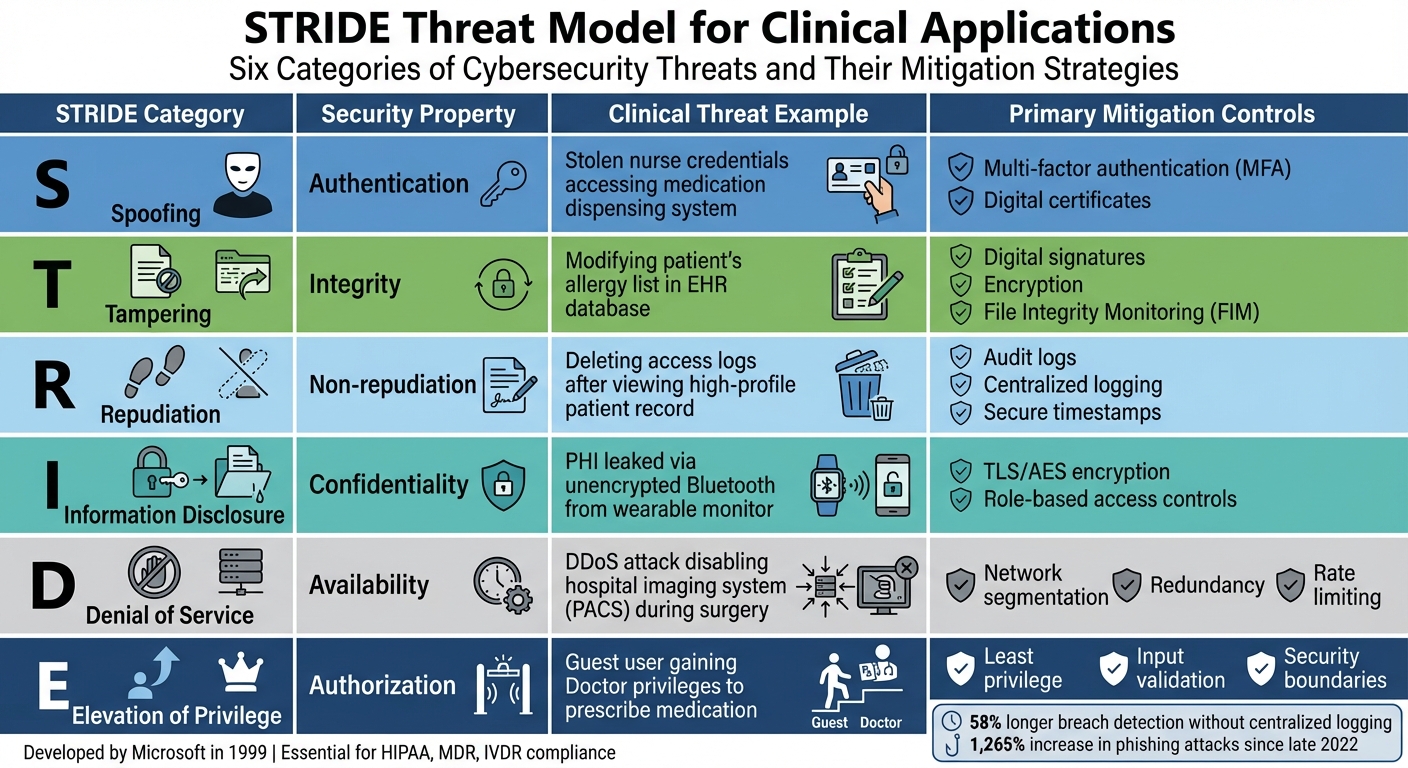
STRIDE Threat Categories and Mitigation Controls for Clinical Systems
STRIDE Threat Modeling for Beginners - In 20 Minutes
The 6 STRIDE Threat Categories for Clinical Systems
Each STRIDE category aligns with a core security principle that clinical software must uphold. In healthcare, understanding these threats is essential for creating systems that not only protect patient data but also safeguard lives. The table below outlines how these categories translate into real-world clinical scenarios.
| STRIDE Category | Security Property | Clinical Application Example |
|---|---|---|
| Spoofing | Authentication | An attacker using stolen nurse credentials to access a medication dispensing system [2]. |
| Tampering | Integrity | Modifying a patient's allergy list in an EHR database [1]. |
| Repudiation | Non-repudiation | A user deleting access logs after viewing a high-profile patient's record [2]. |
| Information Disclosure | Confidentiality | PHI leaked via an unencrypted Bluetooth connection between a wearable monitor and a tablet [2]. |
| Denial of Service | Availability | A DDoS attack disabling a hospital's imaging system (PACS) during surgery [7]. |
| Elevation of Privilege | Authorization | A guest user gaining "Doctor" level privileges to prescribe medication [7]. |
In clinical risk assessments, threats are evaluated using a framework that combines probability (ranging from "Improbable" to "Frequent") with severity (from "Negligible" to "Severe"). This approach helps teams focus on the threats that pose the greatest risks to patient safety.
"Any medical software manufacturer that wants to meet information security requirements cannot ignore STRIDE. It offers a transparent, scalable, and practical method for integrating cybersecurity into the entire development process."
- Daniel Saffer, CTO, MEDtech Ingenieur GmbH [9]
Each STRIDE category is crucial, and the following sections explore their real-world impact in clinical contexts, along with strategies to mitigate them.
Spoofing Threats in Clinical Applications
Spoofing attacks target authentication systems, allowing attackers to impersonate legitimate users or devices. For instance, stolen clinician credentials could grant access to Electronic Health Records (EHR), or a malicious device could mimic a trusted medical peripheral [2]. Imagine a rogue Bluetooth thermometer feeding false data into a monitoring system - this could lead to incorrect treatment decisions.
To counter spoofing, multi-factor authentication (MFA) is key. By requiring more than just a password, MFA ensures that even if credentials are stolen, unauthorized access remains difficult [2].
Tampering Threats in Clinical Applications
Tampering involves altering data or code without authorization, which can compromise the integrity of clinical information. Examples include changing patient vitals during transmission or modifying medical device configurations to alter treatment parameters [1][2]. A tampered infusion pump, for instance, could deliver incorrect doses, endangering patients.
To prevent tampering, clinical systems should use digital signatures and encryption to detect and block unauthorized modifications, ensuring data remains intact during storage and transmission [2].
Repudiation Threats in Clinical Applications
Repudiation threats arise when systems fail to log actions adequately, allowing users to deny their activities. This could involve erasing audit logs to hide unauthorized access or falsely claiming no involvement in a medical transaction [2]. Such gaps can disrupt investigations and undermine compliance efforts.
Robust audit logs are essential. These logs should record every clinical transaction - complete with timestamps, user details, and actions - and must be stored securely to prevent tampering or deletion [2]. This ensures accountability and supports legal and regulatory processes.
Information Disclosure Threats in Clinical Applications
Information disclosure occurs when sensitive data, like Protected Health Information (PHI), is exposed to unauthorized parties. Risks include unencrypted data transmissions or revealing database details through poorly designed error messages [2]. For example, an unencrypted Bluetooth connection between a wearable heart monitor and a tablet could leak sensitive data, putting patient privacy at risk.
The consequences of PHI breaches can be severe, including regulatory fines, lawsuits, and damage to reputation. Clinical applications must employ TLS encryption for all network communications and avoid exposing sensitive details in error messages. Encrypting data at rest and implementing strict access controls based on clinical roles are additional safeguards [2].
Denial of Service Threats in Clinical Applications
Denial of Service (DoS) attacks aim to disrupt access to clinical systems, potentially delaying critical care. This could involve overwhelming a hospital's network to block patient record access or overloading medical devices so they malfunction [2]. For example, a DoS attack on a Picture Archiving and Communication System (PACS) during surgery could prevent access to vital imaging studies.
To mitigate DoS threats, clinical systems should implement rate-limiting on APIs and network interfaces, limiting the number of requests from any single source [7]. Emergency "break-glass" procedures should also be in place, allowing authorized staff to access critical data during outages [2].
Elevation of Privilege Threats in Clinical Applications
Elevation of privilege occurs when attackers gain higher-level access than intended, compromising both system integrity and patient safety. For instance, a low-level user exploiting a vulnerability to gain administrative rights could modify hospital-wide protocols or access all patient records [2].
The principle of least privilege is the cornerstone of defending against such threats. Users should only have access necessary for their roles, and permissions should be regularly audited to identify unauthorized changes. Disabling unused features and ports further reduces the risk of exploitation [2]. By enforcing role-based access controls, clinical systems can maintain tighter security and reduce attack opportunities.
How to Apply STRIDE to Clinical Software Development
Incorporating STRIDE into clinical software development starts from the design phase, embedding security into the system's architecture right from the beginning. This approach ensures vulnerabilities are identified early, using visual tools and systematic analysis to address potential risks before they become critical.
"Cybersecurity isn't something you can bolt on later. It needs to be part of the conversation from the very first architecture draft, and it must evolve throughout the device's lifecycle."
To begin, analyze how data flows within the system, pinpoint what needs protection, and identify potential attack entry points. Each layer of this process builds a detailed security framework tailored to your clinical application.
Creating Data Flow Diagrams for Clinical Systems
Data Flow Diagrams (DFDs) are essential for STRIDE threat modeling, breaking down clinical systems into five key elements: Processes (e.g., dose calculation logic or authentication services), Data Stores (like EHR databases or device caches), Data Flows (such as HL7 messages or Bluetooth transmissions), Interactors (patients, doctors, or lab systems), and Trust Boundaries (the divide between trusted and untrusted components) [5][10].
Each element in a DFD is vulnerable to specific STRIDE threats. For example, processes are exposed to all six threat categories, while data flows and data stores are particularly at risk for tampering, information disclosure, and denial of service. Interactors, whether human or system-based, are mainly susceptible to spoofing and repudiation [10].
| DFD Element | Applicable STRIDE Threats | Clinical Example |
|---|---|---|
| External Entity | Spoofing, Repudiation | Patient, Physician, Lab System |
| Data Flow | Tampering, Information Disclosure, Denial of Service | HL7 message, Bluetooth stream |
| Data Store | Tampering, Information Disclosure, Denial of Service | EHR Database, Local Cache |
| Process | All six STRIDE categories | Dose calculation, Auth service |
DFDs in clinical systems can also highlight "magic sinks" or "sources", where sensitive data appears or vanishes without explanation - often signaling security weak points. Even data flows within trusted boundaries should be scrutinized under defense-in-depth principles [10].
"STRIDE is often applied alongside Data Flow Diagrams (DFDs) to model system architecture, data movements, trust boundaries, and user interactions."
- Chris Romeo, VP Security Compass [5]
During this phase, look for ways to reduce attack surfaces by eliminating unnecessary entry points, such as unused Bluetooth connections or open ports, simplifying the system's overall security [2].
Identifying Assets in Clinical Environments
Securing a clinical system starts with identifying its critical assets. These include digital data, physical documents, intellectual property, and institutional knowledge, all of which are vital to maintaining a secure environment [2].
Clinical assets typically fall into these categories:
- Patient and Medical Data: Sensitive details such as medical records, billing information, appointment logs, and real-time vitals like glucose levels or temperature.
- System Components: Includes web apps (frontend and backend), databases, and APIs.
- Device-Specific Assets: Firmware, device settings, and communication protocols like Bluetooth Low Energy (BLE).
- Identity and Access Assets: User credentials for patients and healthcare providers, as well as digital signatures and admin login methods.
- Audit and Integrity Assets: Logs, audit trails, and configuration files ensuring system integrity and non-repudiation.
Documenting high-level system details early - such as the system's name, description, and data sensitivity - helps classify assets based on their importance to patient safety, clinical performance, and regulatory compliance (e.g., HIPAA, MDR/IVDR). Once assets are cataloged, their exposure can be mapped to refine the threat model further.
Mapping Attack Surfaces for Clinical Applications
An attack surface includes all potential entry points, such as network interfaces, APIs, and hardware connections, that could allow unauthorized access [2]. Mapping these surfaces systematically highlights high-risk areas.
After identifying assets, the next step is to map out all attack vectors. For example, a cybersecurity analysis in June 2025 of a connected insulin pump revealed critical assets like device firmware, patient glucose data transmitted via Bluetooth, and doctor credentials for adjusting dosages. These assets were aligned with specific attack surfaces to assess threats and their potential impact on patient safety [11].
A Cybersecurity Analysis Matrix can help document how informational assets align with attack surfaces and STRIDE categories. Consider this example:
| Informational Asset | Attack Surface | STRIDE Category | Scenario Example | Hazardous Situation |
|---|---|---|---|---|
| Patient temperature | Thermometer → BLE | Tampering | Attacker intercepts and alters BLE data | Incorrect diagnosis due to false data |
| Patient temperature | Thermometer → BLE | Spoofing | Attacker impersonates the thermometer | System records data from an unauthorized source |
| Patient temperature | Thermometer → BLE | Denial of Service | Attacker floods the BLE connection | Real-time monitoring becomes unavailable |
| Patient temperature | Thermometer → BLE | Elevation of Privilege | Attacker gains admin access via BLE | Unauthorized modification of device settings |
When mapping attack surfaces, revisit trust boundaries and apply defense-in-depth strategies, even within trusted zones [10].
To ensure thorough threat modeling, involve a diverse group of stakeholders, including developers, testers, and Product Owners. Interactive sessions can help uncover all potential entry points [12]. Pay special attention to legacy systems that may interact with the new application, as these older systems often bypass modern security assumptions [12].
"The STRIDE threat model provides a systematic risk analysis methodology, helping us identify necessary measures to mitigate risks."
Careful mapping of attack surfaces not only identifies threats but also guides effective risk mitigation strategies [2].
sbb-itb-535baee
How to Mitigate STRIDE Threats in Clinical Applications
After identifying threats through STRIDE modeling, the next step is to implement targeted defenses. These measures should combine technical safeguards with organizational processes to address vulnerabilities effectively, while being adaptable to the specific needs of healthcare systems.
"Cybersecurity is no longer seen as an option in medical technology; it's a requirement."
- Daniel Saffer, CTO, MEDtech Ingenieur GmbH [9]
Mitigation isn't about piling on every available control - it's about choosing the right defenses for the threats at hand. The Department of Health and Human Services (HHS) has outlined 10 Essential and 10 Enhanced Cybersecurity Performance Goals (CPGs) that help healthcare organizations focus on protecting patient safety [13]. Below, we explore the technical measures that form the backbone of STRIDE threat mitigation.
Technical Controls for Clinical Systems
Technical controls are crucial for addressing each STRIDE category. For example, to counter spoofing, you can use multi-factor authentication (MFA), unique credentials, and digital certificates [2][13]. To prevent tampering, deploy tools like digital signatures, hashes, Message Authentication Codes (MACs), and anti-replay mechanisms such as timestamps. File Integrity Monitoring (FIM) is particularly valuable for detecting unauthorized changes to clinical data or configurations [8][6].
Centralized audit logs with secure timestamps help counter repudiation by ensuring actions are traceable [9][6][13]. Encryption, both for data in transit and at rest, alongside role-based access controls, protects against information disclosure. Denial of service attacks can be mitigated through strategies like network segmentation, redundancy, and rate limiting [6][13].
| STRIDE Category | Security Property | Primary Technical Controls |
|---|---|---|
| Spoofing | Authentication | MFA, Distinct Credentials, Digital Certificates [2][13] |
| Tampering | Integrity | Digital Signatures, Hashes, FIM, Anti-replay (Timestamps) [8][6] |
| Repudiation | Non-repudiation | Audit Logs, Centralized Logging, Secure Timestamps [9][13] |
| Information Disclosure | Confidentiality | Encryption (TLS/AES), Role-Based Access Controls |
| Denial of Service | Availability | Network Segmentation, Redundancy, Rate Limiting [6][13] |
| Elevation of Privilege | Authorization | Least Privilege, Input Validation, Security Boundaries |
The Common Vulnerability Scoring System (CVSS) can be used to evaluate the severity of threats and prioritize fixes [9][6]. Incorporating threat modeling early in the software development lifecycle (SDLC) ensures cost-effective and timely mitigation [6].
Organizational and Procedural Measures
While technical defenses are essential, they must be supported by strong organizational processes and dedicated teams. A multi-disciplinary approach is critical - your threat modeling team should include developers, business leaders, security experts, infrastructure managers, and a Threat Model Coordinator to oversee the process [6][1].
Conduct structured threat modeling sessions to analyze Data Flow Diagrams (DFDs) and address key questions [3][6][1]:
- What are we working on?
- What could go wrong?
- How will we address it?
- Did we do enough?
HIPAA Administrative Safeguards also require formal security management processes, including risk analysis, assigning a security official, and workforce security measures like authorization and supervision [14]. Organizations are required to document their policies, assessments, and actions for at least six years [14].
"The Security Rule is designed to be flexible, scalable, and technology neutral, enabling a regulated entity to implement policies, procedures, and technologies that are appropriate for the entity's particular size, organizational structure, and risks."
- HHS [14]
A follow-up process is essential to ensure threats identified during STRIDE sessions are addressed. An Information System Security Officer (ISSO) should lead this process, typically within 90 days of a session [6][1]. Threat models should be reviewed annually or whenever new features are introduced [3][6]. Document findings in a formal Threat Model Report for ongoing tracking and stakeholder review. Establish clear sanctions for employees who violate privacy or security policies [14].
Using Censinet RiskOps™ for Threat Management
Managing STRIDE threats across multiple clinical applications and vendors requires a centralized platform. Censinet RiskOps™ is designed specifically for healthcare, offering tools to streamline risk assessments, automate corrective action plans (CAPs), and monitor cybersecurity risks tied to patient data, PHI, and medical devices.
The platform's Clinical Impact Tiering system helps prioritize high-risk vendors and applications, focusing attention where it's needed most [15]. With a Digital Risk Catalog™ containing over 40,000 pre-assessed vendors, Censinet accelerates secure procurement by identifying vulnerabilities and missing documentation like Business Associate Agreements (BAAs) [15].
Automated CAPs simplify vendor remediation efforts, while the BioMed Integration feature aligns medical device security with IT workflows [15]. Breach alerts provide early warnings for potential threats, enabling a swift response to prevent data breaches or service disruptions [15].
The platform also supports automated reassessments based on risk tier, ensuring critical systems are reviewed annually [15]. By monitoring fourth-party risks, especially among cloud providers, healthcare organizations can maintain safety across their supply chain. Additionally, the system creates a detailed risk record, which is invaluable for audits and incident reviews [15].
Integrating STRIDE into the Secure Development Lifecycle
Building on STRIDE categorizations and mitigation strategies, integrating these practices into every step of the Secure Development Lifecycle (SDLC) is critical for protecting clinical applications. STRIDE isn’t just a one-time task - it’s an ongoing process that must be embedded into each phase of development. Ignoring security early on can lead to costly rework and leave clinical systems exposed. Instead, by incorporating threat modeling from the planning stages through post-deployment monitoring, you can ensure continuous protection.
"Security isn't a feature, it's a foundation. Start building it from day one with STRIDE." - Security Compass [5]
Shifting security left - addressing threats during the requirements phase rather than patching vulnerabilities later - saves time, reduces costs, and helps ensure compliance with regulations like HIPAA and MDR from the start. Let’s take a closer look at how STRIDE can be integrated into key stages of development.
Threat Modeling During Requirements Gathering
Security requirements often hide within clinical problem statements. For example, a requirement to collect patient data implies the need for authentication, authorization, and encryption [10]. The challenge lies in identifying and addressing these needs before development begins.
Start by reviewing architectural diagrams, business requirements, and project documentation to understand your application’s purpose and technology stack [12]. Then, create a Cybersecurity Analysis Matrix that maps clinical information assets (like patient health records) and attack surfaces (such as APIs or Bluetooth connections) against each STRIDE category [2]. This matrix helps you identify attack scenarios and their potential effects.
For instance, if your clinical portal allows patients to view lab results, apply STRIDE as follows:
- Spoofing: Ensure only authorized users can log in.
- Tampering: Protect results from being altered during transmission.
- Repudiation: Use audit logs to track who accesses data.
- Information Disclosure: Encrypt Protected Health Information (PHI).
- Denial of Service: Keep the portal operational during peak usage.
- Elevation of Privilege: Prevent standard users from accessing administrative features [16].
Prebuilt threat trees for each STRIDE category can guide you during requirements sessions, helping you identify common clinical attack vectors, such as replaying valid messages to trigger duplicate medication orders [10]. Define security success criteria - like confidentiality, integrity, and availability - early on so the entire team knows what "secure" means for your application [10].
"The security goal and threat category are two sides of the same coin, and sometimes it's easier to work from one or the other - on the defense (the goal) or the offense (the threat)." - Loren Kohnfelder, Author and Former Microsoft Security Researcher [4]
Once threats are identified, convert countermeasures into formal security requirements [16]. These requirements set the stage for rigorous testing to ensure controls are effective.
Security Testing and Validation
Use STRIDE-based threats to guide penetration tests and contingency planning [3]. Each threat category should inform specific test cases. For example, if Spoofing is a concern for clinician authentication, your testing should attempt to bypass multi-factor authentication or exploit compromised credentials.
Threat trees can help generate test cases by identifying specific attack patterns. These patterns act as "leading questions" to validate whether threats have been mitigated [8]. Use the Common Vulnerability Scoring System (CVSS) to prioritize testing based on the severity of threats, factoring in attack vectors, complexity, and potential damage [9].
Integrate STRIDE controls into CI/CD pipelines for continuous validation. Tools like Semgrep (static analysis), Trivy (container scanning), and OSV-scanner (dependency checks) can automatically block deployments that violate STRIDE-mapped controls. For example, if your threat model requires digital signatures for build artifacts to prevent Tampering, configure your pipeline to reject unsigned builds.
To maintain security at runtime, use policy-as-code frameworks like Open Policy Agent (OPA). These frameworks validate infrastructure configurations against your threat model, catching issues before they reach production [17].
Assign specific security controls for each STRIDE threat:
- Spoofing: Short-lived tokens.
- Tampering: Signed builds.
- Repudiation: Append-only logs with integrity validation (e.g., AWS CloudTrail).
- Information Disclosure: Encryption at rest (AES-256) and in transit (TLS 1.2 or higher).
- Denial of Service: Rate limiting and circuit breakers.
- Elevation of Privilege: Just-in-time (JIT) access controls [17].
Develop a Cybersecurity Analysis Matrix to evaluate risks across communication channels, documenting attack scenarios and sequences of events for clinical assets like patient vitals [2]. This matrix serves as a blueprint for comprehensive testing.
Continuous Monitoring and Updates
Security doesn’t stop after deployment. Continuous monitoring ensures that controls remain effective over time, addressing runtime threats like zero-day vulnerabilities that static models can’t predict [5]. This is especially important for clinical systems, which are increasingly reliant on microservices and third-party APIs, expanding their attack surfaces daily.
"Cybersecurity isn't something you can bolt on later. It needs to be part of the conversation from the very first architecture draft, and it must evolve throughout the device's lifecycle." - Silvia Vilches, Medical Device Consulting Line Director [11]
Automate vulnerability scans with tools like Semgrep and Trivy to validate STRIDE-mapped controls continuously [17]. Use append-only logs with digital signatures to address Repudiation threats and automate secrets rotation with tools like HashiCorp Vault or AWS Secrets Manager to counter Spoofing risks [17]. Implement JIT access for sensitive permissions, granting access only when necessary and revoking it automatically to mitigate Elevation of Privilege [17].
Keep threat models as living documents, updating them whenever new vendors are onboarded or authentication mechanisms change [17]. Without centralized logging and audit trails, organizations take 58% longer to detect and contain breaches [17]. With phishing attacks rising sharply - up 1,265% since late 2022 - continuous monitoring is essential for protecting patient safety and ensuring compliance.
Platforms like Censinet RiskOps™ simplify this process by automating risk reassessments and providing breach alerts. By monitoring risks across the entire supply chain, healthcare organizations can respond quickly to threats and maintain a detailed risk record for audits and incident reviews. This proactive approach safeguards clinical systems while ensuring compliance with evolving regulations.
Conclusion
In clinical environments, cybersecurity plays a vital role in protecting both patient lives and sensitive information. The STRIDE framework offers healthcare organizations a systematic way to identify vulnerabilities across six key areas: Spoofing, Tampering, Repudiation, Information Disclosure, Denial of Service, and Elevation of Privilege. This goes beyond simply meeting regulatory requirements like MDR, IVDR, or HIPAA - it's about maintaining trust, safeguarding patients, and ensuring clinical systems remain dependable.
"Cybersecurity isn't just about protecting data - it's about protecting lives." - Silvia Vilches, Medical Device Consulting Line Director, Rephine [11]
Statistics highlight the urgency: without centralized logging, it takes 58% longer to detect and contain breaches [17]. Meanwhile, phishing attacks have skyrocketed by 1,265% since late 2022 [17]. Healthcare organizations can't afford to rely on reactive security measures. STRIDE encourages a proactive approach by embedding threat modeling into every phase of the Secure Development Lifecycle. From requirements gathering to continuous monitoring, STRIDE helps uncover vulnerabilities before they can be exploited. This approach emphasizes the importance of integrating security measures early and consistently.
To maximize STRIDE's effectiveness, apply it during the architectural design phase, before any code is written. Regularly update threat models - ideally annually or after significant changes - and use a risk matrix to prioritize issues with "Major" or "Severe" impacts. Automating validation through CI/CD pipelines further strengthens security by embedding STRIDE-mapped controls into development workflows [3][17][2]. These steps align closely with clinical risk management strategies, reinforcing both technical and organizational safeguards.
For healthcare organizations managing clinical applications, medical devices, and vendor risks, platforms like Censinet RiskOps™ offer a streamlined way to integrate these practices. By automating risk assessments, creating Corrective Action Plans, and providing continuous oversight of risk exposure across supply chains, healthcare leaders can protect patient safety while meeting compliance standards. Moreover, these efforts help justify cybersecurity investments to executives and Boards of Directors. Treating cyber risks as enterprise risks ensures not only patient safety but also the integrity of the organization as a whole.
FAQs
What are the benefits of using the STRIDE model in clinical software development?
The STRIDE threat model offers a structured way to identify and tackle security vulnerabilities in clinical software development. It breaks threats into six categories: Spoofing, Tampering, Repudiation, Information Disclosure, Denial of Service, and Elevation of Privilege. This categorization helps developers focus on specific risks and implement targeted security measures.
By addressing these threats early in the development process, STRIDE helps protect patient data and ensures compliance with healthcare regulations. Using this model strengthens the security of clinical applications, lowering the chances of breaches or unauthorized access that could compromise patient safety or disrupt system functionality.
What are some examples of STRIDE threats in healthcare environments?
STRIDE threats pose serious challenges to both patient safety and data security in healthcare settings. Consider tampering: this could mean unauthorized changes to medical device settings or alterations in patient records. Such interference might lead to incorrect diagnoses or even harmful treatment decisions. Similarly, spoofing occurs when an attacker pretends to be a healthcare provider or device, gaining access to sensitive systems or patient data without permission.
There’s also the risk of information disclosure, where sensitive patient health information (PHI) is exposed. This not only breaches privacy but can also have long-term implications for the individuals affected. Meanwhile, denial of service (DoS) attacks can disrupt critical clinical applications or disable medical devices, putting patient care at serious risk.
These examples highlight the importance of using STRIDE as a framework to identify and address potential vulnerabilities in clinical software and healthcare systems. By doing so, healthcare providers can better protect patient safety and maintain the integrity of sensitive data.
How can healthcare organizations use the STRIDE model to enhance their security processes?
Healthcare organizations can leverage the STRIDE threat model to enhance their security processes by identifying and addressing vulnerabilities during the development of clinical applications. STRIDE breaks down threats into six categories: Spoofing, Tampering, Repudiation, Information Disclosure, Denial of Service, and Elevation of Privilege. By dividing systems into smaller components and defining trust boundaries, teams can identify potential attack surfaces and mitigate risks early in the development cycle.
To make STRIDE effective, it's crucial to integrate threat modeling right from the design phase and keep it updated as systems evolve. This approach ensures security measures are proactive rather than reactive. Tools like Censinet RiskOps™ can simplify risk management by enabling collaborative assessments and helping healthcare teams protect sensitive data, including patient records and clinical systems. Adopting a structured and continuous STRIDE process supports a strong cybersecurity strategy in the ever-changing healthcare environment.

