
Medical device pen testing in 2026 is about one thing: finding attack paths that could affect patient care before they do.
If I had to boil this guide down fast, I’d say this:
- Patient safety now sits close to cyber risk
- FDA rules now require cybersecurity work before and after release
- A pen test must tie findings to device risk, safety impact, and fixes
- Testing should cover the device, firmware, apps, APIs, cloud links, wireless, and hardware ports
- A weak report is just a flaw list; a strong report drives fixes, retesting, and risk decisions
That shift is happening for a reason. 80% of healthcare groups hit by a medical device cyberattack said patient care saw a moderate or major impact. And in 2026, 56% of HDOs rejected a device purchase over cybersecurity concerns, up from 46% in 2025.
Here’s the short version of what matters most:
- Scope by risk, not just CVSS
- Test in lab settings when live care could be affected
- Focus on paths that could change therapy, alarms, updates, or recovery behavior
- Retest after firmware changes, new disclosures, or device incidents
- Use cross-team review to decide fixes, compensating controls, and residual risk
I also see a clear message behind the guide: a medical device pen test is no longer just a security exercise. It now supports FDA submissions, postmarket work, vendor risk management, and care continuity.
If you want the plain-English version, this article shows how I’d connect pen testing to regulatory rules, patient harm scenarios, test depth, reporting, and follow-up action in 2026.
Regulatory and Standards Baseline for Medical Device Pen Testing
FDA cybersecurity expectations in 2026
In 2026, FDA cybersecurity expectations focus on what manufacturers must submit and what they must do after a device ships. Section 524B of the FD&C Act requires cybersecurity information in 510(k), PMA, De Novo, PDP, and HDE submissions for cyber devices. It also requires manufacturers to monitor and address vulnerabilities after release.[13]
FDA guidance groups testing into four categories: security requirements testing, threat-mitigation testing, vulnerability testing, and penetration testing. In plain terms, a pen test report can't just list issues. It should connect each finding to a specific risk and to the controls listed in the device security risk management file.[2][3][11][12][14]
Postmarket duties matter just as much. Section 524B(b) requires manufacturers to monitor, identify, and address vulnerabilities within a reasonable time, including through coordinated vulnerability disclosure programs.[13] Penetration testing should happen again after major firmware changes, after newly disclosed component vulnerabilities, or when field reports suggest a path to exploitation.[1][8]
Those rules directly shape how teams set scope, run tests, and document the work.
How AAMI TIR57, IEC 81001-5-1, and NIST shape testing
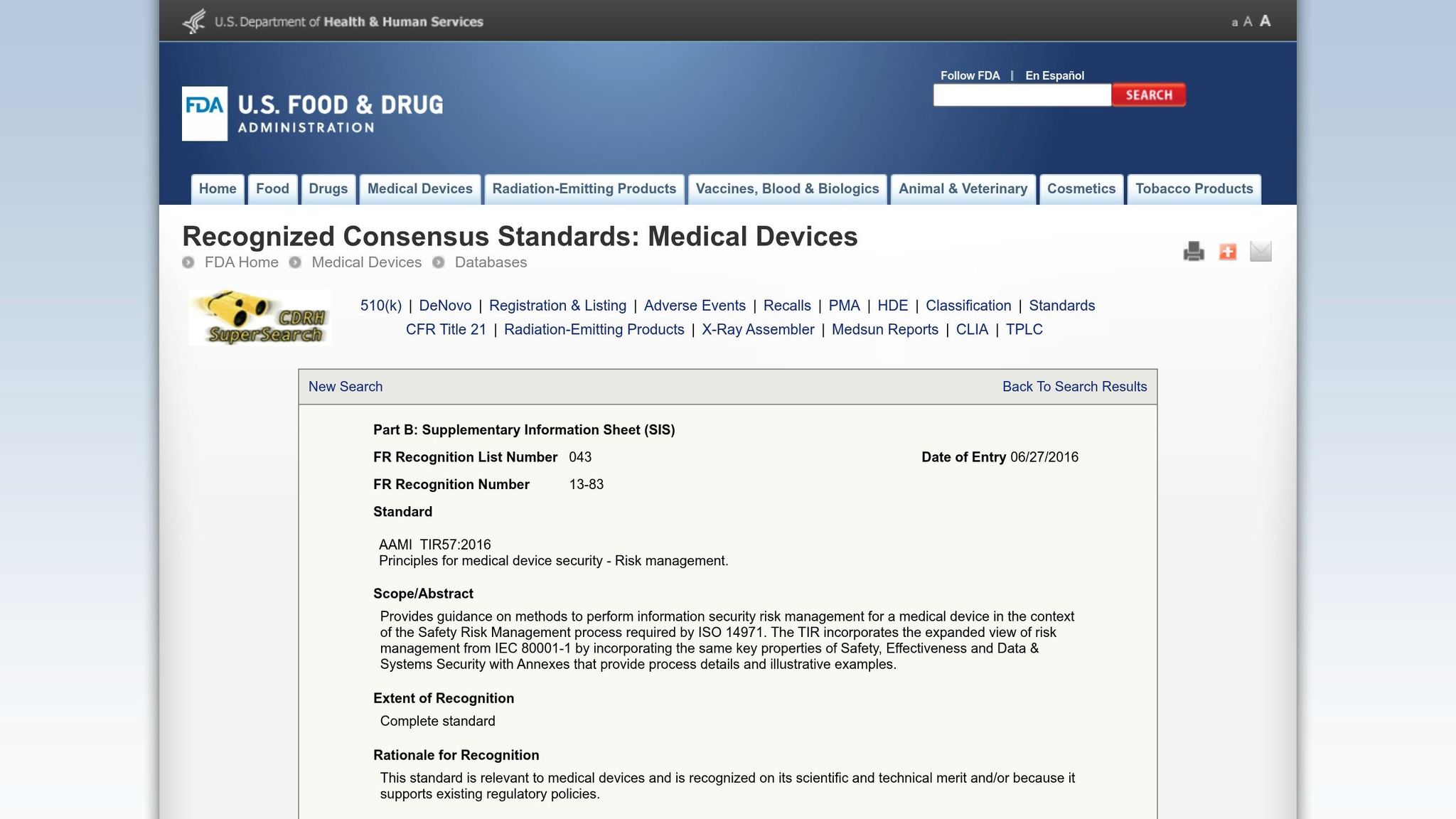
AAMI TIR57:2016/(R)2023 is an FDA-recognized consensus standard that ties information security risk management to the ISO 14971 safety risk management process.[10][16][18] That link matters. In practice, pen test findings should flow into the security risk management file, map to threat scenarios, and connect to clinical impact and control decisions.[5][6][7]
IEC 81001-5-1 says security work needs to sit inside the product development process, including testing as part of verification and validation, not tacked on at the end.[9][15][17] So if testing shows weak credential handling or gaps in logging, those findings should lead to design fixes and updated verification work.[3][4][6]
For HDOs, NIST control families help teams map device findings to enterprise actions, especially when network or operational controls need to pick up the slack. Common references include:
- Access Control (AC)
- Audit and Accountability (AU)
- System and Communications Protection (SC)
- Configuration Management (CM) [1][5]
That sounds straightforward on paper. In devices, it's often anything but.
Why medical devices are harder to test than standard IT assets
Medical devices are harder to test than standard IT assets because many still run legacy operating systems, rely on proprietary protocols, and offer limited telemetry and logging.[5][6][7] That alone makes testing tougher. Add patient care to the mix, and the margin for error gets small fast. Devices like infusion pumps, ventilators, and imaging systems are tied straight to treatment, so aggressive testing on live systems is rarely a good idea.[5][6]
The safer path is to test in representative lab environments that mirror production users, networks, and data flows. On-network validation should stay limited to low-volume windows. Teams should also document rollback steps and remove any test-only changes before redeployment.[5][6][7]
Those limits shape the scope, the tools, and how deep a test can go.
sbb-itb-535baee
Core Methodology: Scoping and Executing a Medical Device Pen Test
Threat modeling and risk-based scoping
Once the scope and safety guardrails are set, the next job is simple in theory and hard in practice: focus on the attack paths most likely to affect care.
Before testing begins, the scope document should spell out the full target surface. That includes the device model, hardware revision, firmware version, embedded OS, software build, companion mobile or desktop apps, backend APIs, cloud services, and every network or physical interface in use. It should also state what is out of scope, such as shared hospital infrastructure, unrelated production systems, or patient records that aren't needed for the test.
Scoping can't rely on CVSS alone. In a medical setting, a path that could change a drug dosage, silence an alarm, or delay treatment matters more than a low-effort informational disclosure. Rank attack paths by:
- patient safety
- workflow disruption
- data integrity
- availability
A good way to do this is with STRIDE: Spoofing, Tampering, Repudiation, Information disclosure, Denial of service, and Elevation of privilege. It gives teams a clear way to map threats to each system component and connect those threats back to the safety risk assessment. The priority should stay on the paths most likely to affect patient safety, availability, or data integrity.
Execution techniques across device, network, app, wireless, and hardware layers
The threat model then needs to turn into tests at each layer.
| Layer | Key Techniques |
|---|---|
| Device and firmware | Firmware extraction, static analysis, string and symbol review, binary diffing, emulation; check signing, encryption, version checks, and rollback resistance |
| Network | Port and service enumeration, authentication control review, exposed management ports, protocol weakness analysis |
| Application | Web portal, mobile app, API testing; session handling, input validation, token handling, insecure direct object references |
| Wireless | Bluetooth, Wi-Fi, Zigbee, NFC, or proprietary radio; pairing, authentication, encryption, and key management validation |
| Hardware / Physical | UART, JTAG, SWD, SPI, I2C, USB, serial consoles, maintenance ports; check whether interfaces are active in production and whether they require authentication |
Firmware testing needs extra care. Teams should test whether malicious or downgraded firmware can get in through local, network, or service interfaces. That's not a minor issue. A bad update can disable alarms, interrupt therapy, or force downtime. If a partial update failure could leave the device unsafe or unusable, that failure mode should be tested on purpose.
The same logic applies to connected software. If a mobile app or cloud portal can change device settings, pull telemetry, or push updates, it's part of the attack surface. It belongs in scope. For example, a test might check whether a weak API lets one user view another user's device data, or whether a mobile pairing flow can be taken over during setup.
Tool categories, time-boxing, and tester independence
Tools should match the layer being tested. That usually means network scanners, web and API test frameworks, firmware analysis platforms, wireless analyzers, and hardware debug tools.
In clinical settings, time-boxing isn't optional. Test windows should avoid peak care hours and critical procedures. Each session needs clear start and end times, allowed actions, escalation triggers, and a hard stop threshold in case the device starts acting strangely. Short, controlled sessions help limit disruption while still covering the highest-priority attack paths.
Tester independence matters too. Hospitals and manufacturers need findings they can rely on when deciding what to fix first. That means requiring documented experience in embedded, medical device, application, network, and hardware testing, along with organizational separation from development and deployment teams. Those controls help turn test results into evidence that supports patient-safety and operational risk decisions.
Technical Focus Areas, Evidence, and Risk Translation
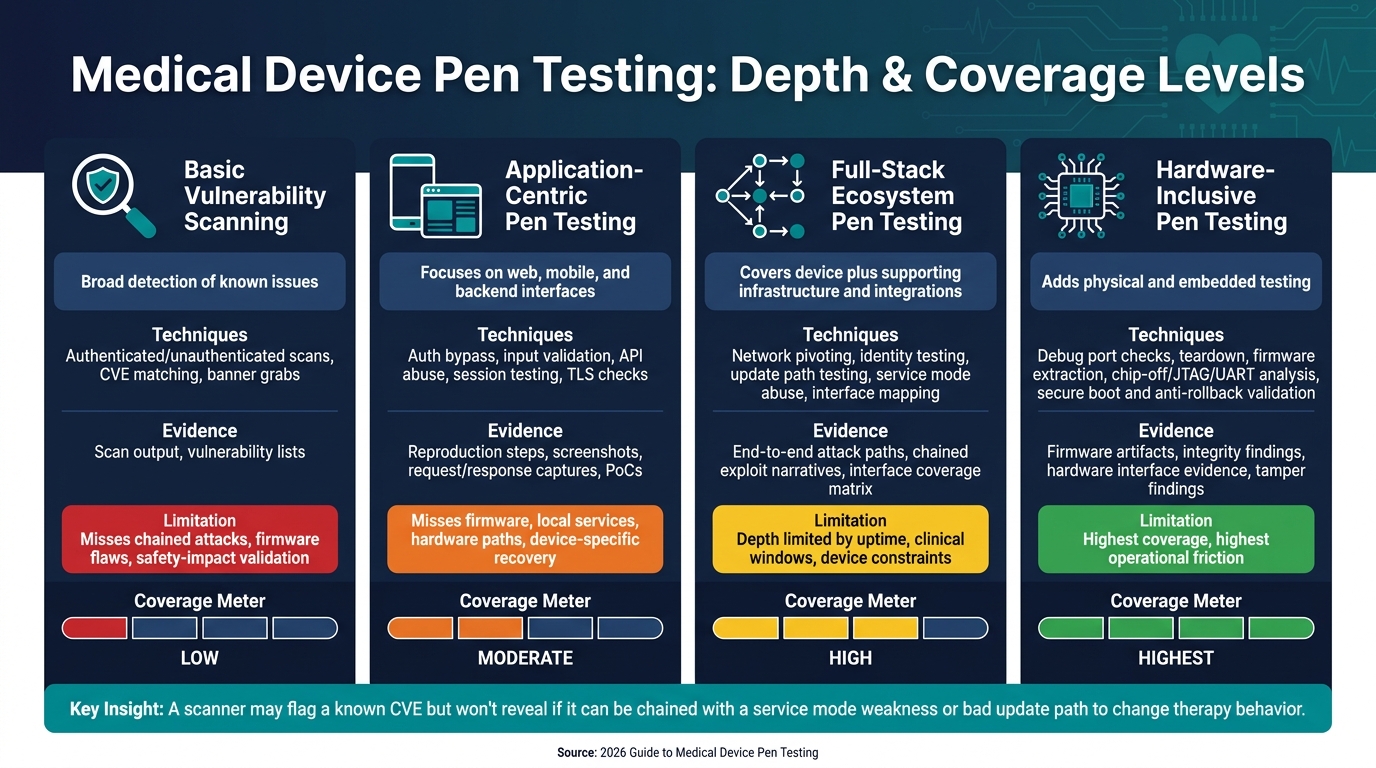
Medical Device Pen Testing Levels: Coverage, Techniques & Limitations
High-priority attack surfaces and patient safety test cases
The layer-by-layer method above sets the stage. From there, the job is to focus on the paths most likely to affect patient care.
Put attention on attack surfaces that can change device behavior, data integrity, or clinical workflow. That includes secure boot, update integrity, rollback resistance, credentials, service modes, network services, wireless links, and PHI handling. The point isn't only confidentiality or availability. It's whether an issue can change how the device acts when care is on the line.
Recent advisories make this hard to ignore. Weak update paths and exposed service functions still rank among the most dangerous failure points. Contec's CMS8000 exposed a hard-coded backdoor across every analyzed firmware version [23], and Baxter's Life2000 had cleartext data, hard-coded credentials, weak access control, and unsigned code download paths [24]. On top of that, authentication weaknesses and code defects made up nearly 60% of medical device advisory disclosures [22].
Test plans should spell out patient-safety scenarios, not just technical checks. Test for failure modes such as:
- Silent therapy interruption
- Unsafe alarm changes
- Unsafe defaults after reboot
- Unsafe behavior after an interrupted update
At the center of all this is a plain question: can a compromise alter therapy, alarms, or recovery behavior?
Comparing testing depth and coverage
Testing depth varies a lot across medical devices. A shallow scan may spot known issues, but it does not prove patient-safety impact. That's why test scope has to match the clinical consequence of the path under review.
| Testing level | Description | Typical techniques | Evidence produced | Common limitations in medical devices |
|---|---|---|---|---|
| Basic vulnerability scanning | Broad detection of known issues | Authenticated/unauthenticated scans, CVE matching, banner grabs | Scan output, vulnerability lists | Misses chained attacks, firmware flaws, and safety-impact validation; scan output alone is insufficient for risk translation |
| Application-centric pen testing | Focuses on web, mobile, and backend interfaces | Auth bypass tests, input validation, API abuse, session testing, TLS checks | Reproduction steps, screenshots, request/response captures, proof-of-concepts | Often misses firmware, local services, hardware paths, and device-specific recovery behavior |
| Full-stack ecosystem pen testing | Covers device plus supporting infrastructure and integrations | Network pivoting, identity testing, update path testing, service mode abuse, interface mapping | End-to-end attack paths, chained exploit narratives, interface coverage matrix | Depth is limited by uptime, clinical windows, and device constraints |
| Hardware-inclusive pen testing | Adds physical and embedded testing | Debug port checks, teardown, firmware extraction, chip-off/JTAG/UART analysis, secure boot and anti-rollback validation | Firmware artifacts, integrity findings, hardware interface evidence, tamper findings | Highest coverage, highest operational friction |
In practice, the gap between these levels matters. A scanner might flag a known CVE, but it usually won't show whether that flaw can be chained with a service mode weakness, a bad update path, or a local interface issue to change therapy behavior. That's where deeper testing earns its keep.
What strong pen test reporting looks like in 2026
Once testing is done, the value comes down to one thing: how well the results are documented and translated. A strong report doesn't stop at listing flaws. It connects technical findings to clinical, engineering, and risk decisions.
The table below shows the core sections a report should include, what each section is for, and the medical device details that make the report useful in practice.
| Report section | Purpose | Key medical device-specific details to include |
|---|---|---|
| Scope | Define what was tested and what wasn't | Device model, hardware revision, firmware version, software build, network topology, clinical context (intended use, risk class), integration points (EHR, PACS, remote monitoring), and explicit exclusions with rationale |
| Methodology | Explain how testing was conducted | Testing levels applied, tools used, manual techniques, constraints, and test environment description |
| Tester qualifications | Establish credibility and independence | Certifications, embedded/medical device experience, and independence from development/deployment |
| Versions tested | Enable traceability | Exact software, firmware, and hardware revisions, build dates, and configuration baselines so findings remain traceable when updates are released |
| Proof-of-concept evidence | Prove findings are real and reproducible | Step-by-step reproduction, sanitized screenshots, packet captures, firmware hashes, and code snippets - carefully redacted to avoid broad disclosure of exploitable details |
| Risk rating rationale | Explain why each finding is rated as it is | Severity, likelihood, and patient-safety impact |
| Remediation guidance | Tell teams what to fix and how | Prioritized fixes, compensating controls such as network segmentation and monitoring rules, and validation steps for future testing |
| Residual risk decisions | Record what risk remains and who accepted it | Risks accepted, transferred, or mitigated; reviewed by both technical and clinical stakeholders; suitable for ongoing tracking in enterprise risk platforms |
Technical severity scores on their own often distort actual risk. A medium-severity finding in a therapy-controlling device may be critical in day-to-day use. The report should say that plainly, tying each finding to a concrete patient harm scenario in language that clinical, engineering, and risk teams can all understand.
Used well, the report becomes more than a record of test results. It turns findings into remediation priorities, compensating controls, and accepted residual risk. The next step is to convert those findings into risk decisions, remediation work, and retesting.
Integrating Pen Testing Into Healthcare Risk Management
How HDOs and manufacturers should act on findings
Once testing ends, the next job is simple to say and harder to do: triage the findings, assign owners, and retest. A pen test report has no value if it just sits in a folder. It needs to drive action.
Start with clinical impact first and technical severity second. That distinction matters. A moderate weakness in a life-support or imaging device can matter more than a higher-scoring issue on a low-impact asset. In practice, prioritization should be driven by four things: exploitability, patient-harm potential, PHI impact, and clinical workflow disruption. Then assign ownership across security, clinical engineering, compliance, procurement, and the vendor. After that, review residual risk in a cross-functional steering committee.[25][29][30][19][31][26][27][28]
For manufacturers, findings should feed straight into release decisions and design control. Run one full-scope pen test on a near-final build before submission or release. Use independent testers and make sure they cover all external interfaces. High and critical findings should be fixed, retested before release, and logged in the design-control record.[20][26][27]
Retesting should also happen after major software or firmware updates, new integrations, disclosed vulnerabilities, incidents involving similar devices, or deployment changes.[25][1][28]
If patching is delayed because of regulatory limits, downtime windows, or vendor timelines, don't just wait and hope for the best. Put compensating controls in place while remediation is underway, such as:
- Network segmentation
- Restricted remote access
- Least-privilege vendor access
- Enhanced monitoring[31][32]
Contract language plays a big part here too. HDOs should require vendors to acknowledge vulnerability reports, investigate them, and commit to set remediation timelines. Procurement agreements should also require patch timeline disclosure, vulnerability-handling procedures, and support commitments before purchase. Coordinated vulnerability disclosure duties should be written into contracts from the start, not bolted on later.[25][29][3][21]
Using Censinet RiskOps™ to manage device-related cyber risk at scale
At scale, all of this needs one shared risk workflow. Censinet RiskOps™ gives teams a centralized way to manage medical device risk by linking pen test findings to vendor assessments, remediation tracking, and compliance records.
Censinet AI™ helps move the work along by automating evidence validation, summarizing vendor documentation, logging fourth-party risk exposures, and drafting risk summary reports. That means teams can act on current risk data instead of relying on an old report.
Conclusion: Medical device pen testing essentials for 2026
In 2026, medical device pen testing is a continuous risk-control process. It matters only if it changes remediation, vendor accountability, and day-to-day risk tracking.
FAQs
How often should a medical device pen test be repeated?
Medical device penetration testing doesn’t happen once and then disappear into a binder. It continues across the full device lifecycle.
Test pre-market to support FDA submissions. Then keep testing post-market so you can deal with new threats as the device stays in service.
In 2026, annual penetration testing is required to support security posture and compliance. You should also repeat targeted testing after major changes to architecture, components, trust boundaries, or data types. Devices with higher risk may need testing more often.
What should be included in scope for a device pen test?
The scope should cover the entire medical device cyber ecosystem, not just a few hand-picked areas.
That means looking at every component that connects to a network or handles data, including:
- Hardware
- Firmware
- Mobile apps
- APIs
- Cloud interfaces
It should also review entry points like USB, serial connections, Bluetooth, and Wi-Fi. And it needs to include clinically relevant attack scenarios while accounting for all components listed in the SBOM.
How do pen test findings affect FDA submissions and postmarket duties?
Pen test findings need to be written up as FDA-ready evidence and tied straight to the device’s cybersecurity risk management.
For premarket submissions, include the scope and methods, the detailed findings, and how each vulnerability maps to risks, controls, and residual risk. You should also include the required artifacts. The goal is simple: show what was tested, what was found, what it means for patient and device risk, and how that risk is being handled.
Postmarket, those same findings do more work. They support:
- ongoing vulnerability monitoring
- remediation and patching
- threat model and SBOM-linked risk updates
- CAPA closure
- coordinated vulnerability disclosure under Section 524B
That way, the pen test doesn’t just sit in a report. It becomes part of the device’s full cybersecurity record across both submission and life cycle activities.
