
Your vendor list is wrong if it treats cost or PHI access as the main test for critical status. I’d judge vendors by four things instead: care disruption, downtime impact, recovery difficulty, and whether a tested backup path exists.
Here’s the short version:
- A low-cost vendor can still stop patient care.
- A vendor with little PHI access can still shut down access, messaging, devices, billing, or labs.
- Fourth-party risk can turn several “low-risk” vendors into one shared point of failure.
- A signed BAA proves terms were accepted. It does not prove review, testing, or follow-up.
- If a vendor outage can affect diagnosis, treatment, medication, claims, or system access within 1 to 24 hours, I’d treat that vendor far more seriously.
What I’d look at first:
- Patient care impact: Does failure delay treatment, meds, records, or emergency response?
- Business impact: Does it stop claims, payments, scheduling, or access to systems?
- Access and control: Can the vendor change records, push software, use admin tools, or manage devices?
- Recovery reality: Is there a documented, staffed, tested workaround?
- Shared dependency risk: Are multiple vendors tied to the same cloud host, clearinghouse, or identity layer?
That’s the core issue: data risk and outage risk are not the same thing. If I score them together, I can miss the vendors most likely to cause care delays or system-wide downtime.
| What teams often use | What I’d use instead |
|---|---|
| Contract value | Outage effect on care and business |
| BAA status | Dependency in day-to-day workflows |
| Annual review only | Trigger-based reassessment plus monitoring |
| PHI exposure alone | PHI exposure and downtime impact |
| Direct vendor view | Direct vendors plus fourth parties |
If I want a vendor list I can defend during an outage, audit, or board review, I need a simple rule: classify vendors by what breaks when they fail - not by what they cost or what paperwork they signed.
Creating Cyber Resilience: Your Guide to Healthcare Vendor Risk Management [On-Demand Webinar]
sbb-itb-535baee
Why Critical Vendor Lists Get It Wrong
Most critical vendor lists focus on contracts and BAAs. That sounds neat on paper, but it misses the bigger issue: operational dependency.
A vendor can look minor in a spreadsheet and still sit right in the middle of daily clinical work. That gap usually shows up in three places: workflow dependency, PHI-only scoring, and fourth-party concentration.
Procurement Records and Annual Reviews Do Not Show Real Dependency
Procurement records tell you what the organization bought. They do not tell you how deeply that vendor is woven into day-to-day clinical or business workflows.
That distinction matters. Some mission-heavy functions sit inside another vendor's platform and never appear cleanly in procurement records. So the list may look complete while the actual dependency map has holes.
Annual reviews add another problem. Vendors change all the time. Cloud hosting shifts. Subcontractors come and go. Ownership changes. If classification happens only once a year, those shifts can sit unnoticed for months, right up until something breaks. For a vendor map that can change month to month, once a year is just too slow.
PHI Access Is Not the Same as Operational Criticality
A lot of teams still treat PHI exposure as the main signal of vendor risk. But PHI access is not the same thing as operational criticality.
A vendor may touch little or no PHI and still bring care delivery to a stop.
The July 2024 CrowdStrike outage made that painfully clear. A faulty update crashed Windows endpoints and forced health systems to cancel non-urgent surgeries and visits. In plain English: a vendor with no core data role triggered immediate clinical paralysis. The same weak spot shows up with identity, communication, and infrastructure vendors.
Identity providers, clinical communication platforms, and network infrastructure can carry major operational risk even when their data access is limited. That is why a critical vendor list has to look at shared dependencies, not just direct contracts.
Fourth Parties Create Invisible Concentration Risk
Even when a direct vendor is classified the right way, the risk does not stop there.
Most vendors depend on subcontractors, cloud hosts, or shared software platforms of their own. Those fourth-party ties often stay out of formal risk inventories, which means concentration risk can build quietly in the background.
The February 2024 Change Healthcare ransomware attack showed exactly how this works. Change Healthcare served as a clearinghouse. When the platform failed, pharmacies could not process prescriptions, and hospitals could not receive payments. The damage was so severe because many organizations depended on the same underlying platform without seeing that shared dependency.
When several critical systems sit on the same fourth-party infrastructure, one failure can ripple across the whole enterprise and turn many "noncritical" vendors into critical ones at the same time.
Which Vendors Are Actually Critical
A vendor becomes critical based on workflow dependency, outage impact, and available workarounds - not just the category it falls into. Put simply, a vendor is critical when four things line up: how deeply it’s tied into day-to-day work, what access it has, how fast a failure causes harm, and whether there’s any backup path.
The same three failure modes from the previous section - workflow dependency, limited PHI exposure, and fourth-party concentration - can show up in every vendor group below. So category is only the starting point. The real test is outage impact, workaround options, and whether patient care gets disrupted.
Clinical, Revenue-Cycle, Infrastructure, and Device Vendors
Start with the vendors that can stop care delivery or cash flow.
EHR platforms usually sit near the top of any critical vendor list. That makes sense. If an EHR goes down, clinicians may lose the ability to place orders, view records, or document care. At that point, it’s not just an IT problem. It becomes a patient safety event.
Claims clearinghouses also belong in the critical bucket because an outage can stop reimbursement and affect access to care.
Cloud hosting platforms and managed service providers can carry the same weight. They support the systems that other vendors rely on. If that layer goes down, the systems above it can go down too. And when many vendors depend on the same provider, one outage can ripple across multiple services.
Medical device manufacturers add a different kind of risk. Their criticality isn’t driven by data volume. It’s driven by connectivity and patient safety. A connected device with no manual fallback is operationally critical.
Identity, Diagnostic, and AI-Enabled Suppliers
Identity providers can create high operational risk even when data exposure is limited. If staff can’t authenticate, they can’t get into the systems they need to do their jobs.
That same logic applies to any workflow tool. If the outage can’t be worked around manually, the vendor should be treated as critical. AI-driven diagnostic tools can fall into that group too. If the tool has no manual fallback, classify it as critical.
Comparison Table: Operational Criticality vs. Data Sensitivity
The table below separates vendors by operational impact and data exposure. Both matter, but they don’t always move in lockstep. That gap is where many critical vendor lists go wrong.
| Vendor Type | Typical Dependency | Likely Outage Consequence | Data Exposure | Expected Oversight |
|---|---|---|---|---|
| EHR / Clinical Software | Total (primary record) | Clinical operations halt; patient safety risk | High (full PHI) | Continuous monitoring; SOC 2 Type II; annual DR testing |
| Claims Clearinghouse | High (financial) | Revenue cycle collapse; blocked claims | High (financial & PHI) | Weekly performance metrics; strict SLA enforcement |
| Cloud / SaaS Hosting | Infrastructure | System-wide downtime | Large PHI exposure | ISO 27001; SOC 2 Type II; BAA |
| Medical Device Manufacturers | High (life support/diagnostics) | Patient safety event; care disruption | Low to moderate | FDA 21 CFR 820; MDS2; SBOM review |
| Identity Provider (IdP) | High (access control) | Staff locked out of all systems | Low (metadata) | Multi-region redundancy; 99.99% uptime SLA |
| AI Diagnostic Tools | Moderate (decision support) | Delayed clinical decisions; no manual backup | Moderate (images/PHI) | Model drift monitoring; human-in-the-loop requirements |
| Diagnostic Labs | High (diagnosis-dependent) | Clinical errors; delayed diagnosis | PHI exposure | CLIA compliance; BAA |
The middle rows are where teams often get tripped up. Operational dependency and data exposure don’t always rise and fall together.
Next, classify these vendors with defensible criteria instead of label-based assumptions.
How to Reclassify Vendors Using Defensible Criteria
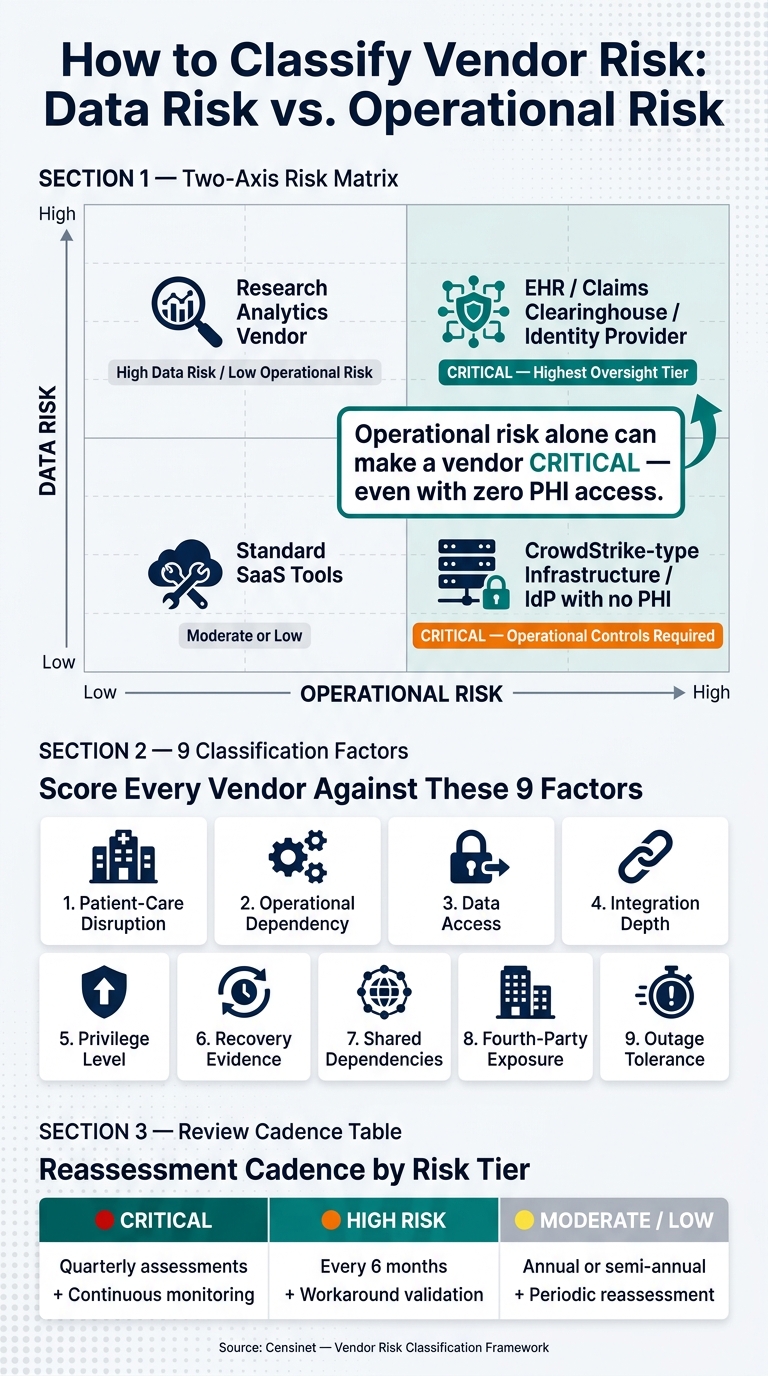
Critical Vendor Classification: Data Risk vs. Operational Risk Framework
Procurement-based criticality labels often look fine on paper, then fall apart during an outage. That’s where the gaps show up. A repeatable method helps close those gaps by replacing informal calls with evidence.
Use four inputs: business impact, security, privacy, and resilience reviews. Together, they give you a clearer basis for classification. From there, score each vendor the same way so the outcome comes from evidence, not labels.
The Decision Factors That Should Drive Classification
Score every vendor against nine concrete factors.
Patient-care disruption comes first. Ask a plain question: if this vendor fails, does it delay diagnosis or treatment, interrupt medication, block records access, stop claims, disable identity, or impair emergency care?
Then look at operational dependency. What stops or degrades if the vendor is unavailable for 1 hour, 4 hours, 24 hours, or several days? Include the services, locations, patient populations, clinical workflows, revenue processes, and regulatory obligations affected.
Next comes data access. Identify what data the vendor creates, receives, maintains, or transmits. Also confirm whether it can export, alter, or delete that information.
Integration depth and privilege level matter just as much. Review items like:
- APIs and interfaces
- Single sign-on
- Network tunnels
- Remote administration tools
- Production credentials
- Device-management privileges
- Software deployment rights
- The ability to modify records or configurations
The remaining four factors matter just as much. Use tested recovery evidence, not stated SLAs, to judge whether the vendor can recover within your tolerance. Map shared dependencies so you know whether multiple critical services sit on the same underlying provider. And review fourth-party exposure to identify which subcontractors and other dependencies also need to be up and working for the vendor to deliver.
Strong security can lower compromise risk. But it does not reduce outage impact.
A Two-Axis Model for Data Risk and Operational Risk
Rate each vendor on two separate dimensions using a low, moderate, or high scale.
- Data-risk tier: sensitivity and volume of data, PHI access, retention period, export capability, privileged credentials, and API exposure
- Operational-risk tier: patient-care impact, revenue-cycle dependency, integration depth, outage tolerance, recovery difficulty, and workaround quality
Treat a vendor as critical only when high operational risk and weak workarounds create real service impact. Use the data-risk axis to set privacy and security controls.
A cloud hosting provider may be high operational risk and moderate data risk. A research analytics vendor may be high data risk but low operational risk. An identity provider may be high on both axes.
Record both scores, the rationale, the owner, controls, and review date.
Decision Table: How Outage Impact, Data Access, and Workarounds Change the Classification
| Data Access | Outage Consequence | Workaround Available? | Classification | Required Response |
|---|---|---|---|---|
| Low or none | Patient care, core infrastructure, or multiple facilities disrupted | No practical workaround; recovery exceeds tolerance | Critical | Enhanced resilience, incident, access, and continuity controls |
| Low or none | Major operational or revenue impact | Manual process exists but is slow, difficult, or untested | High | Validate the workaround; test recovery |
| Low or none | Limited inconvenience; rapid restoration possible | Simple, tested workaround available | Moderate or low | Proportionate controls; periodic reassessment |
| High or sensitive | Limited direct outage effect | Operations can continue within the recovery window | High risk, not critical | Strict privacy, security, retention, deletion, and breach controls |
| High or sensitive | Patient care or essential operations disrupted | No reliable workaround | Critical | Highest oversight tier; tested continuity requirements |
| High or sensitive | Moderate outage effect | Alternate supplier or manual process is tested and available | High data risk, moderate operational risk | Maintain strict privacy controls; reassess after any system change |
A workaround only counts if it has an owner, documented steps, staffing, required access, and a tested run. Once the list is reclassified, apply controls and review triggers that match the new risk tier.
How to Correct and Govern the List
Build a Complete Inventory and Assign Stronger Controls to Critical Vendors
Once vendors are classified, the next job is governance. That’s what keeps the list current and easy to defend.
Pull every vendor source into one inventory. If your data lives in different places, it’s easy to miss gaps, and that’s often where critical vendors slip through. A stale list can turn one bad classification into a long-term risk.
For each critical vendor, map out:
- the systems it touches
- the data it can access
- the internal owner responsible for it
Critical vendors also need tighter oversight. That means added monitoring, testing, evidence retention, and a clearly named owner. A signed BAA shows the parties agreed to terms. It does not show that due diligence happened.
"If your only artifact is signed BAAs, you have documented the promise but none of the diligence - and that is where findings come from." - Medcurity [1]
Vendor gaps should also go into the enterprise risk register next to Security Risk Assessment findings, scan results, and policy gaps. That way, leadership can see the full picture in one place instead of piecing it together across teams. [1]
Once the inventory is complete, set review triggers so it doesn’t drift out of date.
Set Reassessment Triggers, Metrics, and Cross-Functional Accountability
Reassess vendors when contracts change, safeguards shift, services expand, or new vulnerabilities appear. Use continuous monitoring between formal reviews to catch drift early. [1] [2]
For review cadence, the breakdown is pretty clear:
- Critical vendors should get quarterly assessments and continuous monitoring.
- High-risk vendors should be reviewed every six months.
- Moderate-risk vendors can follow an annual or semi-annual cycle.
Track service quality, incidents, evidence, findings, owners, and due dates so accountability stays visible. [1] [2]
Ownership is what turns a review schedule into actual follow-through.
Assign one owner to each critical vendor. Then make the list a standing item for cross-functional review across risk, security, procurement, compliance, legal, clinical engineering, and business teams. It shouldn’t sit on the shelf as a once-a-year compliance task.
Conclusion: A Quick Reassessment Test and How Censinet Supports the Process
Before you close any vendor review, ask four direct questions. What happens if this vendor’s service slows down or stops? How much PHI does it handle, and how tied is it to day-to-day operations? Are any agreements or safeguards out of date? And do you have evidence, beyond a signed BAA, that the vendor meets your control requirements?
If any of those answers is fuzzy, the classification still needs work. A critical vendor list only helps when it stays current, has a clear owner, and is backed by evidence beyond the BAA. Censinet RiskOps™ gives risk, security, and compliance teams one central place to manage vendor inventories, assessments, and evidence. [2]
FAQs
How do I know if a vendor is truly critical?
Look past the size of the contract and focus on what would happen if the vendor failed. A vendor is critical when that failure could disrupt patient care, expose PHI or privileged access, or bring core work like claims processing or scheduling to a halt.
Check four areas:
- Clinical impact
- Data exposure
- Operational dependency
- Downtime tolerance
If there’s no safe workaround, or the vendor is a single point of failure, it likely belongs on your critical vendor list.
What counts as a tested vendor workaround?
A tested vendor workaround is a documented, practical, and safe manual procedure that clinical staff have actually practiced so they can keep operations running during a system outage.
It’s not just a paper plan. The workaround should be checked through live drills or tabletop exercises to make sure staff can carry it out under pressure, keep it going for as long as needed, and continue care safely until the primary system is restored.
How should we assess fourth-party concentration risk?
Look past direct vendor contracts and map the subcontractors, cloud hosts, and shared infrastructure behind your critical clinical and business services. Start with the services most likely to disrupt patient care or cash flow within 72 hours, like EHR access, claims processing, and pharmacy workflows.
Then use API logs, outbound traffic, authentication activity, and SBOMs to spot shared choke points. Rank those choke points by clinical criticality, data sensitivity, and outage impact. After that, test fallback procedures with tabletop exercises.
