
Healthcare’s vendor review problem is simple: too many teams ask the same third-party risk assessment questions, and too few people have time to review the answers. When 58% of the 77.3 million people hit by healthcare breaches in 2023 were affected through third parties, repeated assessments stopped being just paperwork.
Here’s the core idea: healthcare does not need one fixed assessment process. It needs shared risk data that different organizations can reuse. That means vendors can share items like SOC 2 reports, HITRUST results, questionnaire responses, and test records across many customers, while each hospital, payer, or partner still makes its own decision.
If I boil the article down, it says 4 things:
- One mandatory workflow does not fit every vendor
- Shared control mappings matter more than one shared form
- Reused evidence can cut repeat work, but it does not equal approval
- People still own the final risk call, especially for high-risk clinical vendors
A few numbers make the point clear:
- Only 14% of healthcare organizations say their IT security teams are fully staffed
- 30% say they are understaffed or severely understaffed
- Orlando Health cut turnaround from 4–6 weeks to 2–4 weeks
- Analyst time fell from about 180 minutes to 90 minutes per assessment
Creating Cyber Resilience: Your Guide to Healthcare Vendor Risk Management [On-Demand Webinar]
sbb-itb-535baee
Quick comparison
| Topic | Full standardization | Federated network |
|---|---|---|
| Process | One set workflow for all | Each organization keeps its own process |
| Evidence use | Vendors rework the same data many times | Shared records can be reused after review |
| Risk decision | More centralized and fixed | Local team keeps decision rights |
| Fit for third-party vendor risk management | Same path for low and high risk | Review depth can match risk level |
| Human review | Can drift toward checklist review | Stays tied to local context and use |
My takeaway: the article argues for standardizing the language of risk, not the decision process itself. That gives healthcare groups a way to cut duplicate reviews, move vendors through faster, and keep accountability where it belongs. This approach is central to how organizations transform healthcare third-party risk management using collaborative networks.
Why Full Standardization Does Not Fit Healthcare
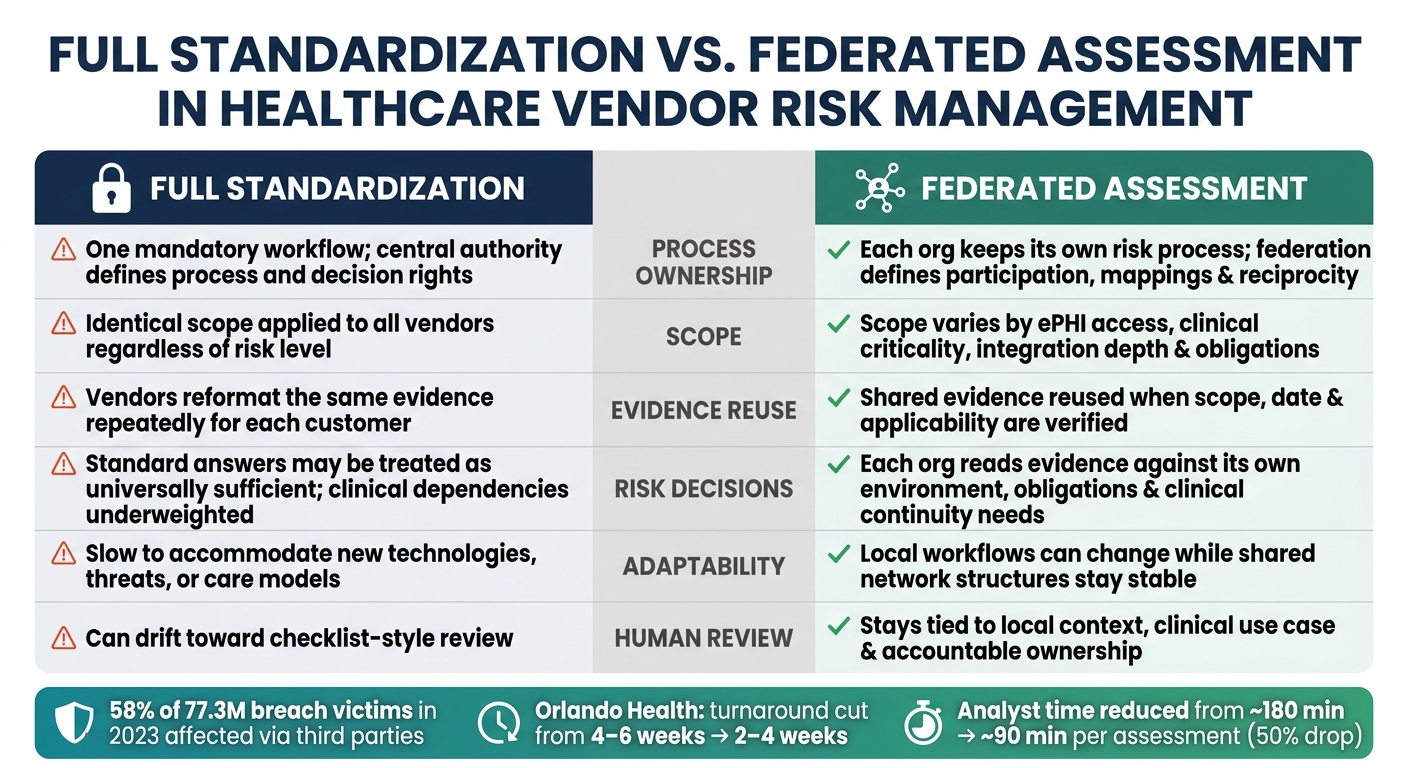
Full Standardization vs. Federated Assessment: Healthcare Vendor Risk Management Compared
Federation works only if the network can support different levels of review while keeping a shared way to talk about risk. In healthcare, organizations deal with different vendors, system dependencies, and regulatory duties. A single mandatory workflow sounds neat on paper, but in practice it creates a mismatch: low-risk suppliers get too much scrutiny, while high-impact clinical vendors may not get enough. The network needs to bend by vendor type, not push every relationship through the same level of review.
Different Vendor Relationships Require Different Levels of Review
Not all vendors carry the same weight. A facilities supplier that never touches ePHI or connects to clinical systems has a very different risk profile than a cloud-based EHR integration platform. The review depth should match that gap.
A facilities supplier may need only a short intake. A clinical platform, on the other hand, calls for a deeper look at access controls, encryption, recovery, interfaces, dependencies, and availability. Availability commitments also need to be checked against clinical continuity needs and manage threats to patient care. If a system goes down during care delivery, the impact is far from minor.
HIPAA does not require one universal process. HHS says covered entities and business associates must perform an accurate and thorough assessment of risks to the confidentiality, integrity, and availability of ePHI, then put in place safeguards that are reasonable and appropriate for the organization’s circumstances.[3][4] That wording leaves room for a risk-based, tiered approach. It does not point to one fixed evidence checklist for every vendor.
Assessment depth should follow factors such as:
- PHI access
- Clinical criticality
- Integration depth
- Fourth-party exposure
- Operational dependence
- Risk appetite
Existing Vendor Evidence Rarely Maps Cleanly to One Mandatory Process
Most vendors already keep a stack of security documents: SOC 2 reports, HITRUST assessments, penetration test summaries, business continuity plans, and policy sets. The issue is simple: those materials rarely line up neatly with every customer’s review process without some interpretation.
A SOC 2 report may apply to a product line or hosting region, but not the exact service being purchased. A HITRUST assessment may be several months old, while the vendor’s architecture has already shifted. Even terms that seem plain - like access review or incident response - can mean different things to the vendor and the customer. On top of that, a vendor’s controls may assume the healthcare organization has set up identity, logging, encryption, or data retention correctly on its own side. That shared-responsibility model can slip past a fixed checklist.
Reviewers should check date, scope, exclusions, subcontractors, and whether the evidence applies to the product being bought.
A control crosswalk can help connect frameworks like NIST CSF, HITRUST, HICP, CAIQ, SIG, and local controls. That kind of mapping helps people translate between frameworks, which is useful. But translation is not proof. Two controls can look similar on paper and still differ in scope or strength. Each healthcare organization still has to confirm that the evidence is current, in scope, and tied to the specific service under review.
Full Standardization vs. Federated Assessment: A Direct Comparison
The gap between the two models is easier to see side by side.
| Dimension | Full Standardization | Federated Assessment |
|---|---|---|
| Process ownership and governance | One mandatory workflow; central authority defines the process and decision rights | Each organization keeps authority over its own risk process; federation defines participation, permissions, mappings, and reciprocity |
| Scope | Broadly identical scope applied to all vendors | Scope varies by ePHI access, clinical criticality, integration, and obligations |
| Evidence reuse | Vendors reformat evidence again and again for each customer | Shared evidence is reused when scope, date, and applicability are checked |
| Shared control language | One required questionnaire or control set | Common mappings connect HICP, NIST CSF, HITRUST, CAIQ, SIG, and local controls |
| Risk decisions and clinical context | Standard answers may be treated as universally sufficient; clinical dependencies may get too little weight | Each organization reads the evidence against its own environment, obligations, and clinical continuity needs |
| Adaptability | Slow to accommodate new technologies, threats, or care models | Local workflows can change while shared network structures stay stable |
NIST’s Cybersecurity Framework 2.0 supply-chain guidance backs this up directly. It lets organizations scope supplier profiles based on supplier criticality and choose only the relevant categories and subcategories.[2][1]
What a Federated Assessment Network Looks Like in Practice
A federated assessment network gives hospitals, payers, vendors, and affiliates a way to share structured, permission-based assessment data while each party keeps its own risk decisions and stays responsible for them.
Shared Assessment Records and Reciprocal Evidence Reuse
In day-to-day use, this comes down to a shared record. That record can hold questionnaire responses, certifications, audit reports, penetration-test results, PHI handling details, fourth-party exposure, and remediation status.
But reusable doesn't mean auto-approved. Reviewers still need to check whether the evidence is relevant, current, in scope, and suited to their regulatory and clinical risk needs.
For example, a SOC 2 report may help support findings about logical access controls for low-risk administrative software. That same report, though, would still need added testing and contract safeguards for a clinical platform that handles ePHI. So yes, evidence reuse cuts duplicate collection work. It does not hand off responsibility for the final risk call.
Common Control Mappings Create a Shared Language of Risk
Common control mappings give everyone a shared way to talk about risk. HICP is directly aligned with the NIST Cybersecurity Framework, and NIST points to HICP resources that map healthcare practices to NIST CSF subcategories.[6][7] HIPAA-to-NIST crosswalks also show how requirements can relate to each other without treating the frameworks as the same thing.[8]
On the ground, that means a vendor's identity and access management evidence can link to the right NIST CSF outcomes, HICP practices, and HITRUST requirements at the same time, without making every party use one framework.
A crosswalk helps you get started. It is not proof by itself. Reviewers still have to confirm that a control is in place, tested, and relevant to the exact use case in front of them.
Trust, Governance, and Platform Support in Censinet RiskOps™
A federated network works only when participants trust the data moving through it. That trust rests on governance: strong identity and authentication, role-based access controls, clear rules for evidence ownership, version control, expiration tracking, full audit trails, confidentiality protections, and written correction workflows so vendors can fix inaccurate responses and alert affected recipients.
Censinet RiskOps™ supports centralized management of assessment requests, responses, documentation, and longitudinal vendor risk records.[5] That longitudinal record matters because it lets reviewers compare current information with past assessments and spot risk drift over time. A one-time questionnaire can't do that.
Tower Health reported completing risk assessments in less than one week using the platform.[9] Censinet AI also speeds up the process by letting vendors complete security questionnaires in seconds, automatically summarizing evidence, and capturing fourth-party risk exposures.
Automation should handle the busywork, such as:
- Routing requests
- Matching evidence
- Tracking expirations
- Flagging duplicates
- Translating frameworks
People should still keep approval authority for exceptions and high-risk vendors.
The party that submits the record owns its accuracy. The receiving organization owns the final risk decision. With the right governance, the network can cut duplicate review work without weakening accountability.
How Federation Reduces Assessment Work and Speeds Decisions
Fewer Redundant Questionnaires and Faster Vendor Onboarding
Once a network can share trusted evidence, intake gets much faster. Picture a cloud-based scheduling vendor that handles patient information. In a standard process, that vendor may get separate questionnaires from the health system, a payer, and several affiliated hospitals. Each one can run from 100 to 300 questions, and most of them ask the same things.
In a federated workflow, the vendor completes a common baseline one time using a recognized questionnaire such as CAIQ or SIG, then uploads supporting evidence one time as well. After that, each hospital, payer, or affiliate can pull that shared record, check the integration points and data flows tied to its own environment, and ask only for what is missing or out of date.
That changes the rhythm of the work. Instead of repeating the same task for every party, the vendor submits once and supports multiple reviews. At the same time, each organization still keeps its own approval standards.
In practice, teams:
- use the product, data, and clinical impact to assign a risk tier
- reuse existing evidence
- ask only for missing, local, or outdated information
- document residual risk
- route decisions to the right reviewers
Orlando Health reported reducing assessment turnaround time from 4–6 weeks to 2–4 weeks, while analyst effort dropped from about 180 minutes to 90 minutes per assessment - a 50% reduction in both metrics.[10][11]
More Scalable Third-Party Risk Management Across the Vendor Lifecycle
The same approach works after onboarding too. Certifications expire. Subcontractors change. Acquisitions shift scope. New releases can add PHI processing. In a federated model, only the changed parts trigger new questions.
Say a vendor moves to a new cloud hosting provider. That may call for updated evidence on data flows, access controls, and incident notification. But if the disaster recovery program has not changed, there is no reason to rewrite the whole thing. That keeps reassessment tied to what actually changed instead of turning every update into a full do-over.
This makes ongoing review easier to manage when scope shifts, while staying in step with the article's healthcare supply chain security challenges.
High-risk suppliers still go through deeper checks. That includes vendors that host ePHI, support clinical operations, or connect to medical devices. Those reviews can include contract review, fourth-party review, and clinical-safety review. Lower-risk vendors can move through a simpler path. Censinet RiskOps™ tracks expiration dates, remediation aging, and reassessment by risk tier.
Human-Guided Automation Improves Speed Without Removing Accountability
Speed matters, but it only counts if ownership stays clear. Automation can handle the repetitive parts: matching, flagging, routing, and summarizing. Censinet AI™ within Censinet RiskOps™ lets vendors complete security questionnaires in seconds, summarizes vendor evidence and documentation automatically, and captures key product integration details and fourth-party risk exposures.
But there is a clear line it does not cross. Automation does not accept risk for anyone. Final risk acceptance, exception handling, and any decision tied to patient safety stay with the people who own those calls.
Risk teams keep control through configurable rules and review processes. So the system supports the workflow without replacing the judgment behind it. Accountable leaders still own acceptance and exceptions.
Conclusion: Consistent Trust Without Identical Processes
Building on the shared assessment record model above, healthcare doesn’t need identical assessments. It needs a shared language for risk so CAIQ, SIG, HITRUST, and SOC 2 evidence can move across organizations without forcing everyone to start from scratch. The point is consistent risk interpretation, not identical workflows.
That shift leads to practical gains: fewer duplicate questionnaires, faster vendor onboarding, monitoring that stays focused on change, and more time for reviewing material risk. The main lessons are straightforward:
- Common control mappings matter more than one mandatory process. When HICP, HHS cybersecurity performance goals, NIST CSF 2.0, HITRUST, CAIQ, and SIG are mapped to shared control themes, assessments remain comparable.
- Reusable evidence is not automatic acceptance. Shared evidence still has to be current, in scope, relevant, and sufficient for the vendor’s access and clinical impact.
- Less repetition still demands scrutiny. Vendors deal with fewer redundant questionnaires, while healthcare organizations can spend that saved time analyzing material risks and tracking remediation.
- A networked model supported by Censinet RiskOps™ scales cyber risk management without removing human oversight. Automation handles matching, routing, and summarizing; risk acceptance stays with the people accountable for it.
The goal is simple: standardize the language of trust, not every risk conversation. Shared risk language, paired with local risk ownership, is what makes a federated model workable for U.S. healthcare organizations of every size, structure, and risk appetite.
FAQs
How is a federated assessment network different from a standardized process?
A standardized process brings consistency to vendor reviews within a single organization. A federated assessment network does something different: it helps the industry share and reuse assessment work across many organizations.
That shift matters. Vendors can submit assessments and evidence once, then use that same material with multiple healthcare organizations. The result is less back-and-forth, fewer duplicate questionnaires, and less time spent redoing the same review from scratch.
For internal teams, the work changes too. Instead of rebuilding each review, they can focus on checking and confirming shared records.
What evidence can vendors reuse across healthcare organizations?
In a federated network model, vendors upload evidence once to a centralized digital risk catalog, then share that same material with multiple healthcare organizations.
That reusable evidence can include:
- Completed security questionnaires
- SOC 2 reports
- HITRUST certifications
- BAAs
- Policy documents
- Incident response plans
- Penetration test summaries
- Business continuity plans
- Remediation attestations
The payoff is simple: fewer duplicate requests, less back-and-forth, and faster onboarding and assessments.
Who owns the final risk decision in a federated model?
In a federated model, the final risk decision stays with the healthcare organization. The network helps teams evaluate vendors using shared benchmarks, standardized evidence, and automated insights, but it doesn't replace human judgment.
Risk teams and designated stakeholders still review findings, handle exceptions, and approve or reject vendors. Leadership and enterprise risk councils set decision rights, escalation paths, and accountability.
