
If you handle PHI, you need HIPAA. If you sell into healthcare, you will likely need SOC 2 too. That’s the short answer.
I’d sum it up like this:
- HIPAA is law for covered entities and business associates handling PHI
- SOC 2 is an audit report that buyers often ask for during vendor review
- SOC 2 does not equal HIPAA compliance
- HIPAA does not give you a certification
- About two-thirds of security controls overlap
- HIPAA breach notices can have a 60-day deadline
- HIPAA penalties can reach $2.13 million per violation category per year
If I were explaining this to a healthcare team, I’d keep it simple: HIPAA answers the legal question. SOC 2 answers the trust and due diligence question. One helps you stay within federal rules. The other helps you show hospitals, partners, and procurement teams that your controls were reviewed by an outside auditor over time. This process is a critical component of third-party vendor risk management for modern health systems.
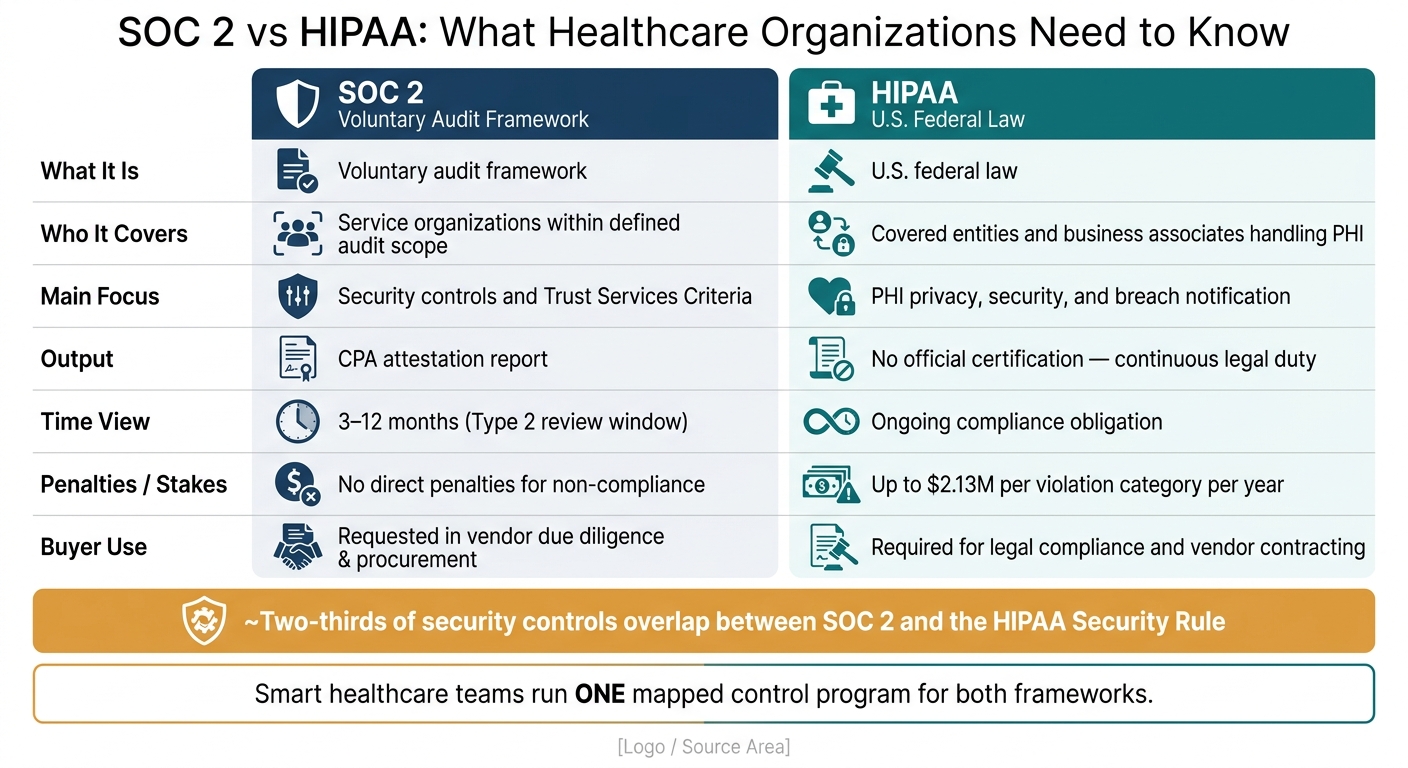
SOC 2 vs HIPAA: Key Differences for Healthcare Organizations
SOC 2 vs HIPAA Compliance: What’s the Difference?
sbb-itb-535baee
Quick comparison
| Criteria | SOC 2 | HIPAA |
|---|---|---|
| What it is | Voluntary audit framework | U.S. federal law |
| Who it covers | Service organizations in audit scope | Covered entities and business associates handling PHI |
| Main focus | Security controls and related trust criteria | PHI privacy, security, and breach notice rules |
| Output | CPA attestation report | No official certification |
| Buyer use | Often requested in vendor review | Used for legal and vendor due diligence |
| Time view | Usually 3 to 12 months for Type 2 | Continuous compliance duty |
| What it does not do | Does not prove full HIPAA compliance | Does not give outside audit proof like SOC 2 |
For me, the main takeaway is clear: healthcare teams should run one mapped control program for both, using shared evidence where possible, while still covering HIPAA-only duties like BAAs, Privacy Rule tasks, and breach notice rules. This unified approach is central to modern healthcare third-party risk management.
SOC 2 vs. HIPAA: Key differences healthcare leaders should know
SOC 2 and HIPAA do overlap. But they are not the same thing, and they do not answer the same question.
The big difference comes down to scope: what each one covers, and what it leaves out.
Here’s the short version:
| Category | SOC 2 | HIPAA |
|---|---|---|
| Who it applies to | Service organizations within the defined audit scope | Covered entities and business associates that create, receive, maintain, or transmit PHI |
| Primary focus | Specific Trust Services Criteria | Privacy, security, and breach notification for PHI |
| What it protects | Scoped systems and data | PHI and related administrative, technical, and physical safeguards |
| How assessment works | Independent audit by a licensed CPA firm | Ongoing legal compliance under federal law; OCR can investigate or audit |
| Evidence expected | Control descriptions, test results, logs, tickets | Risk analyses, BAAs, training records, incident documentation |
| Use in procurement | Speeds healthcare vendor due diligence and shows security maturity | Supports HIPAA due diligence and vendor contracting |
| What it shows | Controls were assessed against selected Trust Services Criteria | The organization meets legal standards for protecting PHI |
Who each framework applies to
HIPAA follows the data. If PHI moves through a system or vendor, that system or vendor is in scope.
That means a cloud-based EHR vendor, billing platform, or another service that handles PHI can fall under HIPAA as a business associate. This includes managing risks for medical devices that process patient data.
SOC 2 works in a different way. Organizations set their own system boundaries at the start of the audit. A vendor can limit a SOC 2 audit to one product or one infrastructure environment and leave other parts of the business outside the review.
That kind of flexibility helps control audit cost and complexity. But there’s a catch: a SOC 2 report only says something about what was actually in scope. Nothing else.
What each framework requires and proves
HIPAA creates legal duties. It does not produce a certificate.
There is no official “HIPAA certified” status. Compliance is a continuous legal condition shown through risk analyses, policies, BAAs, training records, and safeguards. The HHS Office for Civil Rights (OCR) enforces HIPAA, and penalties can reach $2.13 million per violation category per year [1].
SOC 2, by contrast, ends with a formal attestation report from a licensed CPA. A Type 2 report covers a set review window, usually 3 to 12 months, and shows that controls were not only designed properly but also operated as intended during that time [1][4].
For procurement teams, that matters. It gives them a concrete report they can review during vendor due diligence. Still, it is a point-in-time view of selected controls, not proof of legal compliance.
"A SOC 2 report alone typically does not demonstrate compliance with all HIPAA security rules, though it may demonstrate compliance with some of them." - Megan Kovash, Partner, Linford & Co. [3]
The overlap shows up most clearly in shared controls. In plain English, SOC 2 can support HIPAA work, but it does not replace it. The next step is to map where SOC 2 helps with HIPAA control areas - and where that help ends.
Where SOC 2 supports HIPAA without replacing it
About two-thirds of security controls overlap between SOC 2 and the HIPAA Security Rule [1][2]. That matters more than it might seem at first.
If you're in healthcare, building solid SOC 2 controls isn't busywork. A lot of that effort lines up with what HIPAA expects under the Security Rule. Put simply: work you do for SOC 2 can do double duty.
Shared control areas
The table below shows where the two frameworks line up and what that means in practice for your security program.
| SOC 2 control area | Related HIPAA Security Rule expectation | How the overlap helps |
|---|---|---|
| Access controls | Workforce and information access management | Enforces role-based access and MFA to limit PHI exposure |
| Encryption | Transmission security and safeguards for ePHI | Standardizes AES-256 at rest and TLS 1.2+ in transit to reduce disclosure risk |
| Audit logging | Audit controls and activity review | Centralizes logs to improve detection, investigation, and accountability |
| Incident response | Security incident procedures | Provides a tested framework for faster containment and response |
| Change management | System integrity and safeguard management | Reduces risk from unauthorized or poorly controlled system changes |
| Contingency planning | Data backup and disaster recovery | Supports care continuity and system availability during disruptions |
| Vendor oversight | Business associate and third-party risk management | Strengthens due diligence where PHI is shared with subcontractors |
This is why SOC 2 can be a strong input for HIPAA compliance, but not a replacement for it. The overlap is mostly about how security gets carried out day to day. It does not handle HIPAA's legal side. SOC 2 can also give healthcare teams auditor-tested evidence showing that controls worked over a set period.
HIPAA still adds duties that SOC 2 does not test.
What SOC 2 does not fully cover for HIPAA
The gaps are where teams tend to get tripped up.
A SOC 2 report does not cover HIPAA's Privacy Rule duties. That includes the Notice of Privacy Practices, patient rights to access and amend their records, and the duty to account for disclosures [1][2].
HIPAA also sets a 60-day deadline for breach notices. SOC 2 does not. It leaves timing to internal policy. And while HIPAA requires BAAs with every subcontractor that handles PHI, SOC 2 stops at vendor risk management solutions.
Scope can get tricky too. Systems that touch data derived from PHI may fall under both programs.
Why healthcare organizations need both frameworks
HIPAA and SOC 2 do different jobs. In healthcare, that means one alone usually isn't enough.
HIPAA is a legal requirement, not a certification. It sets the rules for how organizations handle PHI. SOC 2, on the other hand, gives outside proof that security controls are in place and working, often requiring a SOC 2 audit documentation checklist. So the smart move isn't choosing one or the other. It's building one program that covers both.
Regulatory readiness plus security assurance
HIPAA sets the legal and day-to-day rules around PHI. SOC 2 adds outside review of the controls used to protect that data.
That matters because a SOC 2 Type II report shows those controls were operating effectively over 3 to 12 months [2][4]. For boards and leadership teams, that's a big shift. Security stops being a set of internal claims and becomes audited evidence. Put the two together, and you get a much more defensible view of risk.
Stronger third-party and enterprise risk management
This is where the overlap becomes hard to ignore: vendor due diligence.
HIPAA requires a signed Business Associate Agreement (BAA) before any vendor touches PHI [2][7]. But a BAA is a legal paper trail. It does not show whether the vendor's controls work in practice.
A SOC 2 Type II report does.
That's why hospital procurement teams in 2026 are explicitly asking for SOC 2 Type II reports in their vendor risk rubrics. Without one, vendors often score poorly, and deals stall - sometimes for months [5]. In plain English, SOC 2 isn't just a security matter anymore. It's also a sales and procurement matter for any vendor selling into healthcare.
The practical answer is simple: use one control framework mapped to both.
How to run both frameworks under one program
Build one control framework and map it across both
Use the overlap between SOC 2 and HIPAA to run one control program, not two. Don’t manage HIPAA and SOC 2 as separate tracks. In practice, a lot of the work you do for one already supports the other.
Start with a single control inventory, then tag each control to both frameworks. For example, your MFA setup can map to both SOC 2 CC6.1 and HIPAA §164.312(d).
After that mapping is in place, use the same evidence set for both. An access control record collected in Q1 can satisfy both SOC 2 CC6.1 and HIPAA §164.312(a) in the same step [6]. Centralized audit logging with 90 days online and 12 months archived supports both frameworks at the same time [5].
Structure helps, but ownership is what keeps things moving. Use one control framework with clear accountability so nothing slips between audits. Recheck scope any time new systems touch PHI. And if an AI tool handles PHI, it needs a signed BAA.
Conclusion: Treat SOC 2 and HIPAA as complementary, not interchangeable
HIPAA is a legal requirement. The moment PHI is involved, compliance becomes mandatory. SOC 2 plays a different role. It gives outside proof that your security controls work in practice, not just on paper.
"HIPAA is mandatory; SOC 2 is the procurement asset. HIPAA gets you legally permitted to handle PHI. SOC 2 Type 2 gets the procurement team's checkbox." - Strac [2]
That overlap between the two frameworks isn’t a problem. It’s a chance to run one control program that covers both legal compliance and buyer assurance.
FAQs
Do we need SOC 2 if we already follow HIPAA?
Yes. HIPAA is a federal law that organizations must follow if they handle PHI. SOC 2, on the other hand, is a voluntary audit framework that helps show a company’s broader security posture.
That’s the key difference: SOC 2 does not replace HIPAA.
Why not? Because SOC 2 doesn’t deal with HIPAA-specific legal duties like Business Associate Agreements, breach notification rules, or patient privacy rights. It can show that an organization takes security seriously, but it doesn’t prove HIPAA compliance on its own.
Still, the two often work well side by side. Their controls overlap by about 60% to 70%, so many organizations use both together.
Which HIPAA requirements are not covered by SOC 2?
SOC 2 and HIPAA aim at many of the same security outcomes, but they are not the same thing.
HIPAA goes further in a few key areas. It also requires:
- Business Associate Agreements with vendors that handle patient health information
- The HIPAA Privacy Rule, including patient rights to access, amend, and track disclosures
- Breach notification rules and secure disposal of PHI
How can we manage HIPAA and SOC 2 in one program?
Build a single control framework instead of running separate compliance workstreams.
The idea is simple: use one control library and map it to both HIPAA requirements and SOC 2 Trust Services Criteria. That way, you can collect evidence once and use it in both places. In many cases, that can cut redundant controls by 30% to 40%.
You can take the same approach with timing. Use one assessment window for areas that overlap, such as:
- access management
- encryption
- audit logging
HIPAA and SOC 2 still stay separate deliverables. But when you manage them together, the process gets more efficient and your security work tends to run with less friction.
