
SMART on FHIR: Role of Tokens in Clinical Interoperability
Post Summary
SMART on FHIR combines the FHIR standard for clinical data structure with OAuth 2.0 and OpenID Connect for secure access control, enabling third-party apps to connect with EHR systems through standardized, token-based authentication - replacing expensive custom integrations with a predictable, scalable protocol.
Access tokens are short-lived credentials - typically valid for under one hour - that authorize specific requests to FHIR resources, while refresh tokens are long-lived credentials stored securely by the app that allow new access tokens to be obtained without requiring the user to re-authenticate.
Asymmetric authentication uses public/private key pairs so the private key never leaves the app's environment and is never transmitted over the network — eliminating the core vulnerability of symmetric authentication where a shared client secret must be sent with every token request and can be intercepted or reused if compromised.
The Authorization Code Flow redirects users to the EHR's authorization server for authentication - keeping user credentials separate from the third-party app - and requires PKCE to prevent authorization code interception, a state parameter with 122 bits of entropy to prevent CSRF attacks, and an audience parameter to prevent token misdirection.
The primary risks are token leakage through server breaches or malicious apps, token redirection attacks that trick systems into accepting tokens at counterfeit servers, and refresh token misuse where long-lived refresh tokens can generate new access tokens indefinitely if compromised — all addressable through audience validation, token rotation, short lifetimes, and scope-based permissions.
Launch context automatically passes patient or encounter-specific identifiers to the app when it is launched from within an EHR workflow, allowing the app to open directly to the relevant patient chart without requiring manual navigation - reducing clinical errors and improving workflow efficiency.
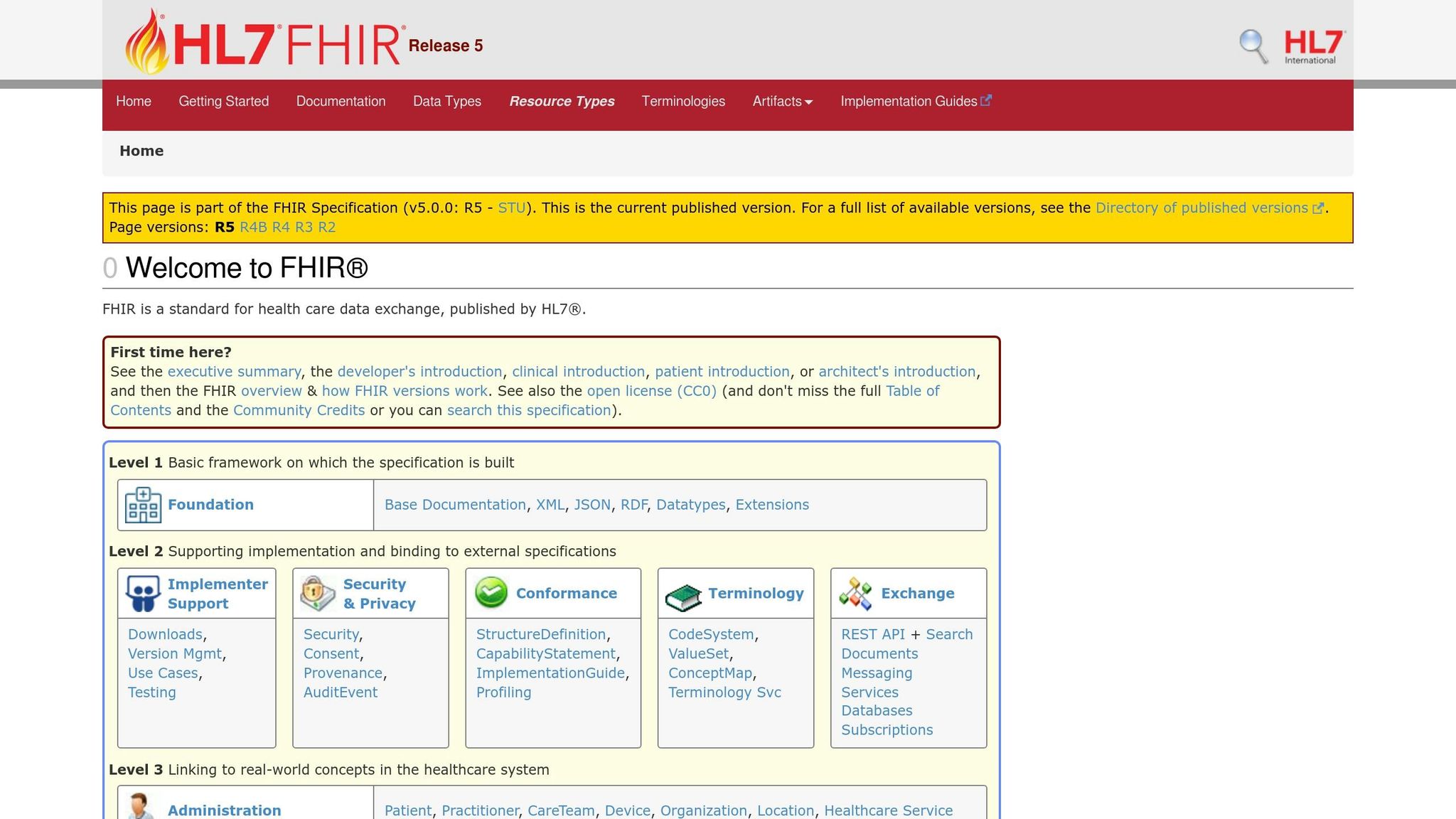
SMART on FHIR is transforming how healthcare systems share and secure data. It combines the FHIR standard for structuring clinical data with OAuth 2.0 and OpenID Connect to ensure secure access. Here's why it matters:
With nearly 90% of U.S. hospitals using APIs for patient data and over two-thirds employing FHIR, this framework is becoming a standard for secure clinical interoperability. By addressing risks like token leakage and enforcing strong security practices, SMART on FHIR ensures safer, more efficient healthcare data exchange.
#2: SMART Access Token Format -- A Guided Walk Through FHIR
sbb-itb-535baee
How Token-Based Authentication Works in SMART on FHIR

Symmetric vs Asymmetric Authentication in SMART on FHIR
When a healthcare app needs to access EHR data through SMART on FHIR, it must first prove its identity. This is done using token-based authentication, where the app requests an access token from the EHR's authorization server. Think of tokens as temporary digital keys that grant specific permissions without exposing sensitive user credentials [4][12]. This system ensures secure, real-time access to patient records during clinical workflows, supporting interoperability by allowing only validated apps to handle sensitive EHR data.
The authentication process uses two main methods: symmetric and asymmetric. Each has its own characteristics, but the SMART standard strongly leans toward one for better security.
Symmetric Authentication with Shared Secrets
Symmetric authentication works a lot like a password system. When an app registers with an EHR, it gets a client_id (a public identifier) and a client_secret (a private password). To request an access token, the app sends these credentials to the authorization server using HTTP Basic Authentication. This involves an Authorization header with the Base64-encoded combination of client_id:client_secret [9].
If the server validates these credentials, it issues an access token. This token is usually valid for about an hour and includes "scopes" that define the app's access level, like patient/*.read for read-only access to patient data [10][4].
While symmetric authentication is straightforward, it has a major security flaw: the client_secret must be sent over the network with every token request. Even though the transmission is encrypted with TLS, it still creates potential vulnerabilities from cyberattacks. If an attacker intercepts the credentials or accesses the server's database, they could reuse the client_secret indefinitely [4][9]. Because of this, symmetric authentication is only suitable for confidential clients that can securely store secrets but can't manage cryptographic keys. Importantly, SMART Backend Services do not support this method [9]. Asymmetric authentication offers a more secure alternative.
Asymmetric Authentication Using Public Keys
Asymmetric authentication uses public/private key pairs, also known as JSON Web Keys (JWK). Here’s how it works: the app generates a private key that stays securely stored and registers the corresponding public key with the EHR. Ideally, this is done by providing a URL to a JSON Web Key Set (JWKS), which allows for seamless key rotation without manual re-registration [8].
To request a token, the app creates a one-time signed JWT assertion to prove its identity. This assertion includes fields like:
The app signs this JWT with its private key and sends it to the authorization server. The server then validates the signature using the app’s registered public key. If everything checks out, the server issues an access token. Since the private key never leaves the app's secure environment, this method is much safer than symmetric authentication [8][4].
"Asymmetric ('private key JWT') authentication... is SMART's preferred authentication method because it avoids sending a shared secret over the wire." - HL7 International
The security benefits are clear. Even if someone intercepts the signed JWT, they can’t reuse it. The jti claim ensures each JWT is valid only once, and the short expiration window (often just five minutes) further limits any potential misuse [8][11]. Some systems, like Greenway Health's authorization server, allow JWT assertions to stay valid for up to 60 minutes, but this is the maximum [13].
Feature
Symmetric Authentication
Asymmetric Authentication
Shared
Public/Private Key Pair (JWK)
Secret sent in HTTP header
Private key never sent; signed JWT
Legacy/Alternative
Preferred Method
Not Supported
Required
Limited to TLS/Session
Built-in via
For healthcare organizations adopting SMART on FHIR, asymmetric authentication is the clear choice. It minimizes risks like credential leaks or reuse and includes built-in protections against replay attacks. While managing cryptographic keys adds complexity, the security benefits make it well worth the effort [4][8].
Token Exchange and Authorization Flows in SMART on FHIR
Token exchange processes are the backbone of secure data sharing in healthcare. They ensure that apps can access electronic health records (EHRs) safely and dynamically. After verifying its identity using asymmetric authentication, an app must gain permission to access EHR data through specific authorization flows.
Authorization Code Flow
The Authorization Code Flow is central to SMART on FHIR because it keeps user credentials separate from third-party apps. When a user launches an app, they are redirected to the EHR’s authorization server to authenticate.
Here’s how it works: Once the user logs in and approves the app's requested permissions, the authorization server sends a temporary authorization code back to the app. This code is short-lived, typically expiring in about one minute [6]. The app then exchanges this code for an access token by submitting it to the token endpoint along with a PKCE (Proof Key for Code Exchange) verifier. PKCE is mandatory for all SMART apps, as it prevents attackers from intercepting or tampering with authorization codes [6].
To enhance security, the app includes a state parameter with at least 122 bits of entropy (like a random UUID) in the authorization request. This defends against cross-site request forgery attacks [6]. Additionally, the aud (audience) parameter specifies the FHIR server’s URL, ensuring tokens aren’t mistakenly sent to malicious servers [6][7].
"The Authorization Code Grant... provides the distinct advantages of 1) enabling the end-user to authenticate directly to the authorization server, avoiding having to share credentials with the client; and 2) enabling the authorization server to transmit the access token directly to the client, rather than exposing it to the user-agent." - HL7 SMART on FHIR Best Practices
During token exchange, the server may also include launch context parameters, such as patient or encounter, to indicate which clinical record is active in the EHR [15]. This ensures the app opens directly to the appropriate patient chart without additional navigation.
Once the app secures the token, it can use refresh tokens to maintain access without repeatedly asking for authentication.
Refresh Tokens and User Identity Scopes
Access tokens are short-lived, typically expiring within one hour [6], to limit portfolio risk in case of theft. However, repeatedly asking users to log in would disrupt clinical workflows. This is where refresh tokens come into play.
Refresh tokens allow apps to request new access tokens without requiring the user to re-authenticate. This ensures uninterrupted access during tasks like long clinical sessions or background data syncing [6][16]. For public clients, such as mobile apps, authorization servers should issue a new refresh token with each refresh response. If an old refresh token is reused, it signals a potential security breach, prompting the server to invalidate the session [7][16].
SMART on FHIR uses refresh tokens to support both active user sessions and background processes. Two key scopes determine their behavior:
In addition to managing access, apps often need to identify the current user. The openid and fhirUser scopes enable this by initiating an OpenID Connect flow. When granted, the app receives an id_token with the user’s identity details, including a URL pointing to their FHIR resource (e.g., Practitioner/123 or Patient/456) [6][15]. This identity information helps apps personalize experiences and maintain accurate audit trails.
Feature
Access Token
Refresh Token
Authorizes requests to FHIR resources
Obtains new access tokens from auth server
Short-lived (typically < 1 hour)
Long-lived (days to months)
Resource Server (FHIR API)
Authorization Server (Token Endpoint)
Memory or short-term storage
Secure, persistent app-specific storage
Token Security and Clinical Interoperability
Token security is a cornerstone of ensuring secure clinical data exchanges and maintaining patient privacy in healthcare systems. With nearly 90% of non-federal acute care hospitals in the U.S. leveraging APIs for patient data access, and over half of health IT vendors integrating FHIR with OAuth 2.0, the importance of robust token security cannot be overstated [2].
At its core, token security relies on how tokens are created, validated, and used. Protocols like OAuth 2.0 and OpenID Connect establish a secure connection between apps and EHRs, while scope-based permissions enforce strict access control. For instance, an app with patient/Observation.read permission can only access observation data, limiting potential damage if the token is compromised [17][1].
Launch context simplifies workflows by automatically sending critical details - such as patient or encounter IDs - to the app, reducing manual errors and improving efficiency [18][2]. Furthermore, token introspection ensures real-time validation of access tokens, confirming their activity status and permissions [17]. Together, these measures enhance secure interoperability across various healthcare platforms.
Symmetric vs. Asymmetric Authentication
The choice of authentication method significantly impacts token security. The SMART on FHIR framework supports both symmetric and asymmetric authentication, but asymmetric methods are preferred. By keeping the private key secure within the client’s environment, asymmetric authentication eliminates the need to transmit shared secrets, reducing exposure risks [17]. Between 2021 and 2023-24, hospital adoption of FHIR-based API access surged from 56% to nearly 70%, with many organizations transitioning to asymmetric methods for enhanced security [2].
Reducing Token-Related Risks
Even with strong authentication protocols, tokens can be vulnerable to various threats:
To address these risks, healthcare organizations can implement several key strategies:
"If a refresh token is compromised and subsequently used by both the attacker and the legitimate client, one of them will present an invalidated refresh token, which will inform the authorization server of the breach." - SMART on FHIR Authorization Guide
Risk Management for Healthcare Organizations
As healthcare organizations increasingly integrate third-party applications, securing clinical systems that rely on token-based authentication becomes a top priority. To safeguard these systems, organizations must ensure that third-party apps meet core security standards. This includes using the Authorization Code Grant model to keep access tokens out of user-agents and enforcing mandatory TLS protocols for secure communication [7]. To address these challenges, many healthcare providers are turning to advanced risk management platforms.
Censinet RiskOps™ is one such platform designed to help healthcare organizations evaluate third-party integrations against critical security benchmarks. It allows teams to assess compliance with practices like refresh token rotation, audience parameter validation, and token introspection [7][10]. By centralizing these evaluations, organizations can proactively identify vulnerabilities, reducing the risk of patient data breaches or disruptions to clinical workflows.
However, risk management doesn’t stop at initial assessments. Continuous monitoring of token-related security measures is essential. For example, third-party apps should implement asymmetric authentication using JSON Web Key Sets (JWKS) and ensure refresh tokens are bound to specific clients [7][14]. For public apps that cannot securely store secrets, refresh token rotation - where a new token is issued with each use - is critical for quickly identifying breaches [7]. These practices align with established security standards and help maintain system integrity.
Sustaining strong token security also requires ongoing oversight. Censinet RiskOps™ facilitates this through automated workflows that monitor third-party risks across clinical apps, medical devices, and supply chains. The platform enables healthcare providers to share security evaluations and compare their token security practices with industry benchmarks. With Censinet AI™, risk teams can streamline vendor questionnaires and validate evidence more efficiently, scaling their efforts while maintaining the human judgment necessary for critical decisions.
To further strengthen defenses, organizations should establish protocols for high-risk scenarios. For instance, they should revoke refresh tokens if a device is lost or limit repeated invalid authorization attempts to prevent breaches [7]. Combining these operational controls with rigorous third-party assessments creates a layered defense strategy for managing token-based authentication risks, particularly in SMART on FHIR implementations. These practices are essential for ensuring secure and interoperable clinical systems under the SMART on FHIR framework.
Conclusion
Token-based authentication under SMART on FHIR plays a crucial role in achieving secure clinical interoperability. By tailoring OAuth 2.0 into a healthcare-specific protocol, SMART on FHIR establishes predictable and standardized connections between applications and Electronic Health Records (EHRs). As Raj Sankuratri explains:
"Plain OAuth 2.0 gives you a framework. SMART on FHIR gives you a protocol. That distinction matters when you are trying to connect healthcare systems at scale"
.
This system’s reliance on short-lived access tokens combined with long-term refresh tokens minimizes risks of unauthorized access. Additionally, granular scopes enforce the principle of least privilege, ensuring that applications only access the data they truly need. Real-world results reflect these benefits: organizations implementing SMART on FHIR patterns report a 30% to 50% drop in support effort post-launch, a 40% reduction in app onboarding time, and apps with embedded SMART flows see 2 to 3 times higher repeat usage compared to those requiring manual patient selection [20].
The move toward asymmetric authentication further bolsters security. By using public-private key cryptography, this approach eliminates shared secret vulnerabilities and strengthens the binding of tokens to specific devices. Combined with mandatory TLS 1.2 (or higher) and audience validation, these measures create multiple layers of protection against token-related threats.
Maintaining such security standards across third-party integrations requires consistent oversight. Tools like Censinet RiskOps™ enable healthcare teams to assess vendor compliance with token security protocols, monitor refresh token practices, and benchmark implementations against industry standards. This proactive approach not only prevents patient data breaches but also supports the seamless workflows critical to clinical interoperability.
As healthcare moves toward open ecosystems and greater patient control over data, token-based authentication under SMART on FHIR provides the scalable infrastructure needed to advance care delivery while safeguarding patient safety and data integrity.
FAQs
When should a SMART on FHIR app use asymmetric authentication instead of a client secret?
When a SMART on FHIR app requires stronger security measures, asymmetric authentication is the way to go. This method involves using asymmetric keys, such as RSA or EC private keys, to manage and sign assertions. It's particularly suited for situations where robust client authentication and secure key management are critical.
How do PKCE and the state parameter prevent authorization code attacks?
PKCE, or Proof Key for Code Exchange, adds an extra layer of security by preventing code interception during OAuth flows. It works by having the client generate a code verifier and a corresponding code challenge. The authorization server ties the authorization code to this challenge. When the client later exchanges the code for a token, it must provide the correct code verifier. This ensures that only the original client can successfully complete the exchange.
The state parameter is another critical security feature. It helps prevent Cross-Site Request Forgery (CSRF) attacks by maintaining a link between the client and server. Essentially, it verifies that the server's response corresponds to the client's original request, ensuring the integrity of the interaction.
What’s the safest way to store and rotate refresh tokens in SMART on FHIR apps?
To keep refresh tokens safe in SMART on FHIR apps, rely on encrypted storage or secure hardware modules to block unauthorized access. Always rotate tokens after each use, set them to expire after a specific period or number of uses, and keep an eye on token activity to spot anything unusual. Plus, make sure to use Transport Layer Security (TLS) for secure transmission, reducing the risk of token compromise.
Related Blog Posts
- IoT Device Authentication for Medical Devices: Guide
- Tokenization vs. Encryption: Which Is Better for PHI?
- FHIR and APIs: Building Secure Healthcare Systems
- How MFA Prevents Email Phishing in Healthcare
{"@context":"https://schema.org","@type":"FAQPage","mainEntity":[{"@type":"Question","name":"When should a SMART on FHIR app use asymmetric authentication instead of a client secret?","acceptedAnswer":{"@type":"Answer","text":"<p>When a SMART on FHIR app requires stronger security measures, <strong>asymmetric authentication</strong> is the way to go. This method involves using asymmetric keys, such as RSA or EC private keys, to manage and sign assertions. It's particularly suited for situations where robust client authentication and secure key management are critical.</p>"}},{"@type":"Question","name":"How do PKCE and the state parameter prevent authorization code attacks?","acceptedAnswer":{"@type":"Answer","text":"<p>PKCE, or <strong>Proof Key for Code Exchange</strong>, adds an extra layer of security by preventing code interception during OAuth flows. It works by having the client generate a <strong>code verifier</strong> and a corresponding <strong>code challenge</strong>. The authorization server ties the authorization code to this challenge. When the client later exchanges the code for a token, it must provide the correct code verifier. This ensures that only the original client can successfully complete the exchange.</p> <p>The <strong>state parameter</strong> is another critical security feature. It helps prevent <strong>Cross-Site Request Forgery (CSRF)</strong> attacks by maintaining a link between the client and server. Essentially, it verifies that the server's response corresponds to the client's original request, ensuring the integrity of the interaction.</p>"}},{"@type":"Question","name":"What’s the safest way to store and rotate refresh tokens in SMART on FHIR apps?","acceptedAnswer":{"@type":"Answer","text":"<p>To keep refresh tokens safe in SMART on FHIR apps, rely on <strong>encrypted storage</strong> or secure hardware modules to block unauthorized access. Always rotate tokens after each use, set them to expire after a specific period or number of uses, and keep an eye on token activity to spot anything unusual. Plus, make sure to use <strong>Transport Layer Security (TLS)</strong> for secure transmission, reducing the risk of token compromise.</p>"}}]}
Key Points:
How does token-based authentication work in SMART on FHIR and what problem does it solve?
- EHR data silos and costly custom integrations are the underlying problem SMART on FHIR addresses - before standardized token-based authentication, connecting third-party clinical apps to EHR systems required bespoke integrations that were expensive, fragile, and inconsistent across vendors
- Access tokens function as temporary digital keys that grant specific, scoped permissions to a requesting app without exposing user credentials - the app presents the token to the FHIR resource server rather than a username and password
- Token scopes enforce least-privilege access - a token with patient/Observation.read permission can only retrieve observation data for the specified patient, limiting the blast radius if the token is compromised
- Token introspection allows resource servers to validate token activity status and permissions in real time at the point of each API call, rather than relying solely on the initial issuance - providing a live verification layer for access control
- Launch context parameters passed with tokens during EHR-initiated app launches automatically provide the app with the active patient or encounter context, eliminating manual selection steps that introduce clinical workflow friction and error risk
Why is asymmetric authentication the SMART on FHIR preferred method over symmetric authentication?
- The core asymmetric advantage is that the private key never leaves the app's secure environment and is never transmitted over the network - the app proves its identity by signing a JWT assertion with the private key, while the EHR validates it using the registered public key
- Symmetric authentication's fundamental flaw is that the client secret must be sent in an HTTP header with every token request - even over TLS, this creates an exposure surface where interception or server database compromise yields reusable credentials with no built-in expiration
- One-time JWT assertions in asymmetric authentication include a jti (unique nonce) claim that prevents replay attacks - each JWT is valid for a single use, typically within a five-minute window, making intercepted assertions operationally worthless
- SMART Backend Services require asymmetric authentication - symmetric authentication is explicitly not supported for backend service-to-service integrations, reflecting the standard's recognition that machine-to-machine contexts cannot tolerate shared secret vulnerabilities
- JWKS URL-based key registration allows seamless key rotation without manual re-registration with the EHR, maintaining security hygiene over time without operational disruption to active integrations
How does the Authorization Code Flow with PKCE protect clinical data in SMART on FHIR?
- User credential isolation is the primary security benefit - users authenticate directly with the EHR's authorization server rather than entering credentials into the third-party app, meaning the app never has access to the user's identity credentials at any point in the flow
- PKCE (Proof Key for Code Exchange) is mandatory for all SMART apps - the client generates a code verifier and challenge pair before the authorization request, binding the authorization code to the originating client so intercepted codes cannot be exchanged by an attacker
- Authorization codes are intentionally short-lived - typically expiring within one minute - limiting the window during which an intercepted code could be exploited before it becomes invalid
- State parameter entropy requirement of at least 122 bits (equivalent to a random UUID) in the authorization request provides CSRF protection by verifying that the server's authorization response corresponds to the specific client request that initiated it
- Audience parameter validation binding tokens to a specific FHIR server URL ensures that tokens issued for one server cannot be redirected to and accepted by a different server - directly mitigating token misdirection attacks in multi-server healthcare environments
What are the operational rules for refresh tokens in SMART on FHIR clinical implementations?
- Online access scope keeps refresh tokens valid only for the duration of the active user session - the recommended default for most clinical app contexts where background data access after user logout is not required
- Offline access scope allows refresh tokens to persist after the user logs out, enabling background data synchronization tasks, but demands stronger security controls, explicit user consent, and clearly accessible revocation options given the extended exposure window
- Refresh token rotation for public clients requires authorization servers to issue a new refresh token with each refresh response - if an old refresh token is presented after rotation has already occurred, it signals that the token has been compromised, triggering immediate session invalidation
- Access token lifetime of under one hour limits the window of unauthorized access if a token is leaked, while refresh token lifetimes of days to months balance security with clinical workflow continuity - the operational tradeoff that the two-token architecture is specifically designed to manage
- Client binding ensures refresh tokens are tied to the specific client that requested them - preventing token theft scenarios where an attacker attempts to use a stolen refresh token from a different application context
What token security vulnerabilities must healthcare organizations manage in SMART on FHIR implementations?
- Token leakage through server-side breaches, malicious third-party apps, or logging systems that inadvertently capture token values represents the most common attack vector - addressed through short access token lifetimes, encrypted storage, and audit log sanitization
- Token redirection attacks exploit misconfigured audience validation to route tokens to attacker-controlled servers that accept them as valid - prevented by strictly enforcing audience parameter matching against the intended FHIR server URL at both issuance and validation
- Refresh token misuse is particularly consequential because long-lived refresh tokens can generate new access tokens indefinitely - making refresh token rotation, client binding, and revocation-on-device-loss protocols essential operational controls
- Scope creep in third-party app assessments - apps requesting broader scopes than their documented function requires - represents a systemic risk in healthcare environments where procurement processes may not evaluate OAuth scope requests against clinical necessity
- Repeated invalid authorization attempts can signal brute force or credential stuffing activity - rate limiting and lockout protocols for token endpoint requests are recommended operational controls that SMART best practices specifically address
How does Censinet RiskOps™ support token security risk management for SMART on FHIR integrations?
- Third-party app security assessments evaluate whether integrated clinical applications comply with SMART on FHIR token security standards - including asymmetric authentication implementation, refresh token rotation practices, audience parameter validation, and TLS protocol enforcement
- Automated vendor questionnaire workflows through Censinet AI™ efficiently gather and validate evidence about how vendors implement token-based authentication, reducing the assessment burden for security teams managing large portfolios of clinical app integrations
- Continuous monitoring of third-party risks across clinical apps, medical devices, and supply chains ensures that token security posture is assessed on an ongoing basis rather than only at initial procurement - reflecting the reality that vendor implementations change over time
- Benchmarking against industry standards allows healthcare organizations to compare their token security practices and third-party integration controls against peer facilities in the Censinet Risk Network, identifying gaps relative to industry norms
- Centralized risk management covering clinical apps alongside medical devices and supply chain vendors provides a unified view of the full third-party security surface - enabling risk-prioritized remediation rather than siloed app-by-app management

