
Risk scoring algorithms are tools that help organizations, especially in healthcare, assess and prioritize cybersecurity risks. These algorithms assign numerical values to threats based on factors like likelihood, impact, vulnerabilities, and active threats. This structured approach helps organizations focus on the most critical risks, ensuring resources are used effectively.
Key highlights from the article:
- What They Do: Convert cybersecurity risks into measurable scores, guiding decision-making.
- How Risks Are Measured:
- Likelihood × Impact
- Threat × Vulnerability × Impact
- Frameworks Used:
- Healthcare-Specific Use: Protect sensitive data like PHI, address vulnerabilities in EHRs, medical devices, and third-party vendor relationships.
- Compliance: Aligns with HIPAA and NIST standards, streamlining audits and regulatory requirements.
- AI Integration: Modern systems use AI for real-time updates, anomaly detection, and continuous monitoring.
Risk scoring algorithms are essential for managing healthcare cybersecurity, from safeguarding patient data to meeting compliance standards. They provide actionable insights to tackle threats efficiently.
Cybersecurity Vulnerabilities: Risk, Scoring (CVSS/CVE), and Management Strategy K0683
sbb-itb-535baee
Core Principles of Risk Scoring Algorithms
Risk scoring algorithms rely on two main principles to translate cybersecurity threats into measurable risk scores. These principles help healthcare organizations shift from subjective evaluations to consistent, repeatable methods for assessing risks across their digital environments.
The Likelihood and Impact Framework
At its core, risk is calculated as:
Risk = Likelihood × Impact
- Likelihood reflects the chance that a specific threat will occur. For example, an internet-connected electronic health record (EHR) system is more exposed to potential threats compared to a standalone medical device.
- Impact measures the severity of the consequences if the threat materializes. In healthcare, this can include financial losses, harm to patients, or disruptions to operations. A ransomware attack on an EHR system, for instance, would likely receive a high impact score because it could paralyze operations and endanger patient safety [4][8].
For example, consider a hospital's outdated PACS (Picture Archiving and Communication System). If it scores 5/10 for likelihood due to internet exposure and known vulnerabilities, and 8/10 for impact because of the potential consequences, the resulting risk score would be 40/100 [4][3].
The Threat-Vulnerability-Impact Model builds on this framework by adding more depth to risk assessments.
Threat-Vulnerability-Impact Model
This model breaks risk down further into three components: active threats, existing vulnerabilities, and their combined impact. The formula looks like this:
Risk = Threat × Vulnerability × Impact
By separating likelihood into distinct evaluations of threats and vulnerabilities, this approach adds precision to risk scoring [8][5].
- Vulnerabilities are evaluated using metrics like the Common Vulnerability Scoring System (CVSS), which rates weaknesses on a scale from 0 to 10, considering factors such as attack complexity and required privileges [7]. In healthcare, this might involve analyzing vulnerabilities in EHR systems, IoT devices, or outdated firmware in third-party systems.
- Threats are ranked using intelligence feeds, such as alerts about phishing campaigns targeting healthcare providers or supply chain attacks. Advanced tools, like Bayesian networks, can also dynamically update threat probabilities as new data emerges - an especially useful feature in hospitals with ever-changing connected device ecosystems [2].
These principles align with regulatory frameworks like NIST 800-66 and HIPAA. They enable healthcare organizations to map protected health information (PHI) assets, evaluate threats, and calculate risk scores that meet compliance standards. This ensures that risk scoring not only addresses technical challenges but also fulfills regulatory obligations, safeguarding patient data while helping organizations allocate cybersecurity resources efficiently [3][5][6].
Common Risk Scoring Methodologies
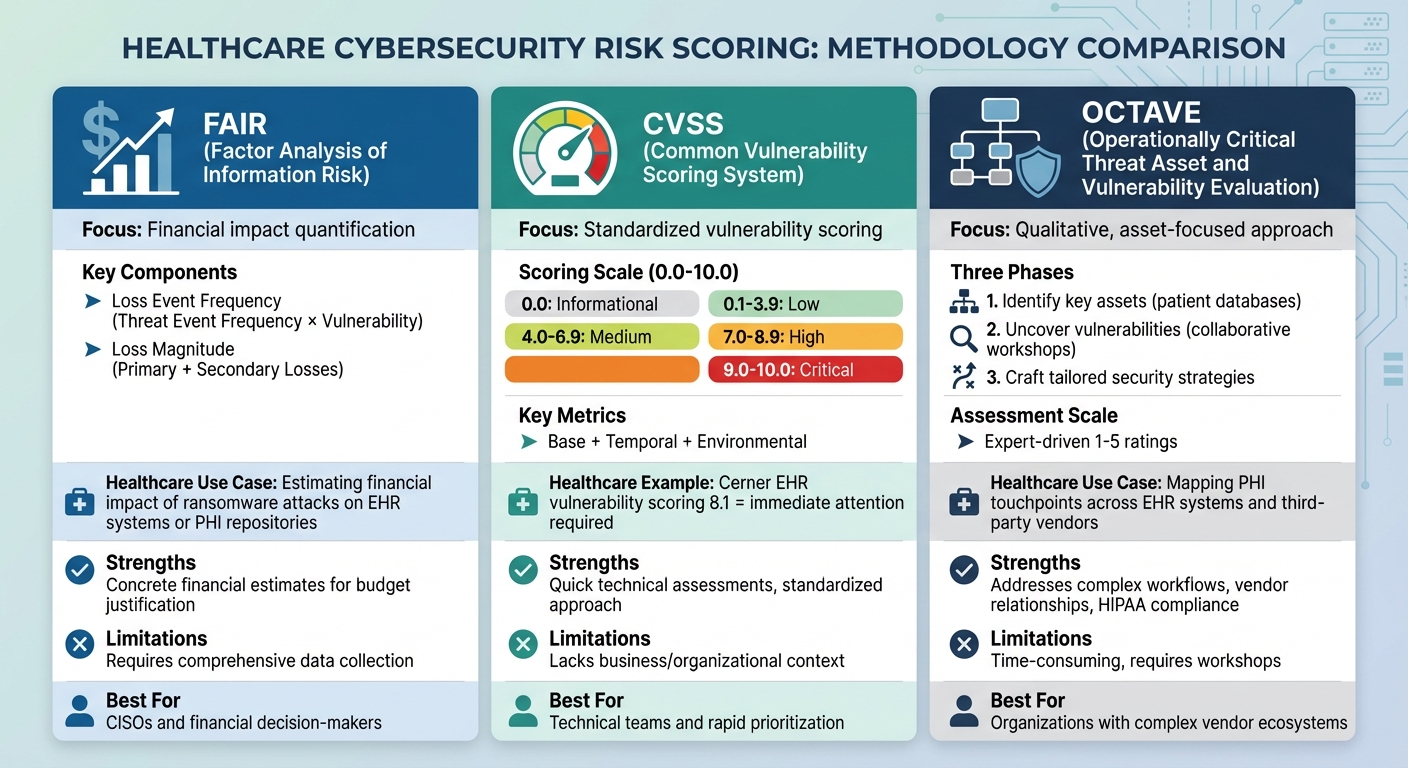
Comparison of FAIR, CVSS, and OCTAVE Risk Scoring Methodologies in Healthcare
Healthcare organizations rely on specific frameworks to turn cybersecurity threats into actionable risk scores. These frameworks help translate technical vulnerabilities into measurable insights, guiding efforts to protect patient data and clinical systems. Three prominent methodologies stand out: FAIR, which quantifies risks financially; CVSS, which standardizes vulnerability scoring; and OCTAVE, which focuses on assets within an organizational context. Each has a distinct approach to addressing cybersecurity challenges.
FAIR Methodology

The FAIR (Factor Analysis of Information Risk) methodology breaks cybersecurity risk into two key elements: loss event frequency (a combination of threat event frequency and vulnerability) and loss magnitude (covering both primary and secondary losses). This framework helps healthcare leaders, like CISOs, estimate the financial impact of specific scenarios - such as ransomware attacks targeting EHR systems or PHI repositories. By generating concrete financial estimates, FAIR allows organizations to prioritize cybersecurity investments and justify budgets. However, its accuracy depends heavily on gathering comprehensive data [2][8].
CVSS (Common Vulnerability Scoring System)
The CVSS framework offers a standardized scoring system for evaluating cybersecurity vulnerabilities, with scores ranging from 0.0 to 10.0 [9]. It combines base, temporal, and environmental metrics to arrive at a final score, helping organizations prioritize responses. For instance, vulnerabilities are categorized as follows:
- 0.0: Informational
- 0.1–3.9: Low
- 4.0–6.9: Medium
- 7.0–8.9: High
- 9.0–10.0: Critical
In healthcare, a vulnerability in a Cerner EHR system scoring 8.1 would demand immediate attention compared to less critical issues. While CVSS enables quick technical assessments, it falls short in addressing broader business or organizational contexts [9].
OCTAVE Framework
Unlike CVSS, the OCTAVE (Operationally Critical Threat Asset and Vulnerability Evaluation) framework takes a qualitative, asset-focused approach. It emphasizes understanding organizational realities through three phases: identifying key assets (like patient databases), uncovering vulnerabilities via collaborative risk assessment questions, and crafting tailored security strategies. OCTAVE often uses expert-driven 1–5 scales to assess risks, blending qualitative and semi-quantitative methods.
This framework is especially suited for healthcare organizations managing complex workflows, vendor relationships, and HIPAA compliance. For example, it helps map PHI touchpoints across EHR systems and third-party vendors while integrating threat intelligence from sources like H-ISAC. However, its depth and reliance on workshops mean that OCTAVE assessments can be more time-consuming than automated scans like CVSS [3][8][9].
Each of these methodologies offers healthcare organizations unique tools to safeguard sensitive patient and operational data, tailoring their approaches to specific needs and priorities.
Risk Scoring Algorithms in Healthcare Cybersecurity
Healthcare cybersecurity has embraced advanced algorithms to protect sensitive data like Protected Health Information (PHI). The sector faces unique challenges that go beyond standard IT environments, including interconnected medical devices, outdated electronic health record (EHR) systems, and complex vendor networks. Risk scoring algorithms transform these vulnerabilities into actionable insights, helping organizations prioritize their security efforts on the most pressing threats.
The stakes are high. Healthcare data breaches can cost more than $10 million per incident, and nearly 60% of healthcare organizations reported ransomware attacks in the past year [10]. Beyond financial losses, these breaches can jeopardize patient safety. A tragic example occurred in 2020 when a ransomware attack on a German hospital led to a patient's death, prompting a manslaughter investigation [11].
"Cybersecurity risk management is no longer merely a compliance requirement; it is now a critical business imperative in the modern digital healthcare environment."
- Monica McCormack, Compliance Copywriter, Compliancy Group [10]
HIPAA Compliance and Risk Scoring
With such high risks, regulatory compliance becomes essential. The HIPAA Security Rule requires healthcare organizations to conduct thorough risk assessments and maintain detailed security documentation. Risk scoring algorithms simplify this process by automating gap analysis, comparing an organization’s current security measures against HIPAA requirements [10]. These tools identify non-compliance areas and assign severity scores, making it easier to prioritize fixes.
For instance, a vulnerability in a patient-facing portal might receive a higher risk score than a minor issue in a backup system. This ensures that limited resources - whether budgets or staff - are directed toward resolving the most critical gaps [10].
Managing third-party vendor risks adds another layer of complexity. Healthcare providers often share PHI with third-party business associates. Risk scoring tools evaluate the security practices of these partners, ensuring they meet HIPAA standards before data sharing begins. Many organizations are also adopting Zero Trust Architecture models, which verify every access request for PHI. Risk scores play a key role here, determining the necessary level of authentication for each request [10].
AI-Driven Dynamic Risk Scoring
Traditional risk assessments provide only a momentary snapshot, but healthcare environments are constantly evolving. New medical devices, software updates, and emerging cyber threats demand continuous monitoring. AI-driven dynamic risk scoring addresses this need by offering real-time insights that adapt to changing conditions [11].
These systems track access patterns and device behaviors, flagging anomalies that may indicate unauthorized PHI access or cyberattacks. AI also evaluates system-wide risks, such as vulnerabilities from outdated software or insecure connections between EHR and laboratory systems. This holistic approach helps identify threats that isolated assessments might miss [11].
"The integration of Artificial Intelligence (AI) into CRM has enabled early identification of risks and errors, further enhancing patient safety measures."
- Gianmarco Di Palma et al., Researchers, Fondazione Policlinico Universitario Campus Bio-Medico [11]
The healthcare sector is transitioning from reactive security to proactive clinical risk management (CRM). AI tools are now being used to predict and prevent risks before they can impact patient safety. This shift aligns with broader Industry 4.0 trends, where interconnected systems like IoT, cloud computing, and AI require automated risk scoring to manage an expanded attack surface [11]. Some advanced systems even incorporate dynamic consent management, using AI and blockchain to ensure patient permissions for data use are up-to-date as clinical needs evolve [11]. Tools like Censinet RiskOps™ exemplify how these advancements are shaping the future of healthcare cybersecurity.
How Censinet RiskOps™ Improves Cybersecurity Risk Scoring
Traditional risk assessments often drag on for an average of 44 days, but Censinet RiskOps™ slashes this timeline to 10 days or less. This speed means organizations can quickly identify and address vulnerabilities, minimizing risks faster than ever [12]. By consolidating fragmented efforts into a single, cohesive view, the platform transforms how risks are managed.
Instead of relying on manual processes that keep departments like IT, BioMed, supply chain, research, and compliance working in silos, Censinet RiskOps™ brings them together. Through a unified "single pane of glass" view, the platform ensures that risks - like weaknesses in a medical device network - are spotted and resolved efficiently.
Automated Risk Assessments with Censinet
Censinet RiskOps™ takes a smarter approach to risk assessments by using dynamic, product-specific questionnaires. These questionnaires are tailored to the environment being assessed, whether it’s cloud applications or on-premise systems. This focused method ensures only the most relevant data is collected, eliminating unnecessary noise.
The platform also integrates inline findings with automated corrective actions. For example, if a vendor’s security practices fall short of HIPAA standards, the system flags the issue, creates a remediation plan, and tracks its progress until the problem is resolved. With continuous monitoring, users gain ongoing visibility into high-risk vendors and any overdue remediation efforts.
Human-in-the-Loop AI for Risk Prioritization
Censinet RiskOps™ doesn’t stop at automation - it incorporates Censinet AI™ to refine risk prioritization with human oversight. This combination of automation and human input streamlines critical steps like evidence validation, policy drafting, and risk mitigation. It also speeds up vendor questionnaire completion, summarizes documentation, flags fourth-party risks, and generates comprehensive risk reports. This allows healthcare organizations to manage risks at scale without losing precision.
The platform acts as a centralized hub, ensuring critical findings are routed to the right stakeholders for review. Risk teams retain control through configurable rules and review processes, so automation enhances decision-making rather than replacing it. Best practices include assigning clear roles across teams like IT and compliance, using risk matrices to map probability and impact, and retraining models regularly with updated data.
Best Practices for Implementing Risk Scoring Algorithms
Ensuring Data Accuracy and Consistency
When it comes to risk scoring algorithms, accurate and consistent data is non-negotiable. Everything starts with a clear plan. Organizations should bring together leaders from compliance, IT security, operations, and other key areas to align on risk assessment goals and define how data will be collected [1]. This collaboration ensures everyone is on the same page from the start.
To make risk scoring more objective, consider using weighted scoring systems. These systems assign numerical values to various risk attributes, like controls, mitigation costs, recovery complexity, and compliance needs [1]. For example, under HIPAA compliance, organizations can use the Confidentiality, Integrity, and Availability (CIA) model. This involves rating controls on a scale of 1 to 10 based on how critical the associated data is [5]. Standardizing these scores across departments helps eliminate inconsistencies and ensures that everyone is using the same yardstick. Plus, documenting these assessments provides a clear record of compliance efforts.
Continuous Monitoring and Updates
Once you’ve established accurate data, the next step is keeping it relevant. Threats evolve, and so should your risk scoring. Dynamic Bayesian models are a great tool for this - they allow for ongoing updates as new vulnerabilities emerge [2]. This keeps your risk assessments current instead of relying on outdated information.
One practical tool healthcare organizations can use is a risk matrix. This maps out the likelihood of a vulnerability occurring against the severity of its impact [1]. It’s particularly useful for prioritizing urgent issues, like ransomware attacks targeting electronic health records [4]. If you’re using different methodologies - such as CVSS, which scores risks on a 0-10 scale with various components [7], or NIST frameworks, which categorize risks as low, moderate, or high [5] - you might notice some inconsistencies. Don’t ignore them. Instead, use these differences as a chance to dig deeper into areas that need more attention [2]. Adopting a mix of approaches can give you a more complete picture of your risks [2].
Finally, don’t underestimate the importance of documentation. Keeping detailed records of your risk assessments and any actions taken to address vulnerabilities is not just a best practice - it’s essential for compliance. During audits by the HHS Office for Civil Rights, these records can demonstrate your commitment to safeguarding patient health information [2]. It’s a simple step that can save a lot of headaches down the road.
Conclusion
Risk scoring algorithms play a crucial role in navigating the challenges of healthcare cybersecurity. By using a data-driven approach to prioritize threats, these tools help organizations focus their resources on the most pressing vulnerabilities [1]. This prioritization not only enhances operational efficiency but also protects patient safety by addressing risks to medical devices, EHR systems, and clinical operations before they lead to harmful incidents [4].
Successful implementations often incorporate frameworks like FAIR, CVSS, and NIST. These methodologies provide a thorough overview of risks, combining numerical accuracy with meaningful context [13]. Additionally, this structured approach offers the documented evidence needed to comply with HIPAA and other regulatory standards [1].
What sets effective risk scoring apart is its ability to adapt continuously. Unlike static assessments, modern systems - often powered by AI - deliver real-time updates and recalculations as new threats arise. By integrating data from tools like network monitoring, endpoint protection, and vulnerability scans, these systems help healthcare organizations maintain a proactive stance against emerging threats [9][14].
To make the most of risk scoring, healthcare organizations must strike a balance between strong cybersecurity measures and smooth day-to-day operations. Protecting patient data and PHI requires clear metrics, reliable data, and advanced tools like Censinet RiskOps™. By adopting this balanced approach, organizations can build a resilient cybersecurity strategy that prioritizes patient safety while meeting regulatory demands [15].
FAQs
How do you choose the right risk scoring method for a hospital?
To choose the best risk scoring method for your hospital, start by aligning the method with your specific goals, available data, and governance structure. Consider different models:
- Qualitative models: Ideal when data is limited, these rely on descriptive assessments.
- Quantitative models: Use numerical data to allow for comparisons and trend analysis.
- Machine learning models: Provide real-time insights, though they may require advanced data and technical expertise.
When evaluating these methods, focus on metrics like calibration, recall, and accuracy to ensure the model identifies vulnerabilities effectively and complies with standards. The key is finding a balance between performance, ease of interpretation, and your organization's capacity to manage the chosen method for robust risk management.
How should CVSS scores be adjusted for real-world clinical impact?
To better reflect the realities of clinical settings, CVSS scores should incorporate a Safety metric in addition to the standard base, threat, and environmental metrics. This addition would provide a clearer focus on patient safety risks and the specific clinical circumstances that are so crucial in healthcare environments.
What data is needed to make AI-driven risk scoring reliable?
Reliable AI-driven risk scoring depends on having a wide range of accurate and diverse data. This includes sources like security questionnaires, vulnerability scans, incident records, certifications, and benchmarking data. Adding elements like health records, medical device information, and network activity can improve precision even further. To keep up with changing threats, regular data updates and careful calibration are essential. This ensures that predicted risk levels stay in line with real-world risks while reducing the chances of algorithmic bias.
