
In U.S. healthcare, patient consent is the default - but emergencies can allow PHI sharing before consent.
Here’s the short answer: I’d explain this topic as a balance between patient choice, fast treatment, and tight oversight. HIPAA usually lets providers share PHI for treatment without a separate authorization, and that matters in a system with 155.4 million ER visits a year, where 40.6% of visits are seen in under 15 minutes. In those moments, waiting can get in the way of care and increase risks to patient safety.
What readers need to know right away:
- Consent for treatment is different from HIPAA authorization for data disclosure
- In routine care, access usually follows recorded patient preferences and staff roles
- In emergencies, PHI may be shared without prior consent for treatment, some caregiver updates, or a serious threat
- The minimum necessary rule usually does not apply to treatment disclosures between providers
- Emergency override access, often called break-the-glass, should be time-limited, logged, reviewed, and tied to a stated reason
- After the event, teams should review access and, in some cases, notify the patient or representative
A simple way to think about it: consent comes first when care is routine; treatment comes first when delay could harm the patient. But even then, access should stay controlled, logged, and open to review.
| Topic | Routine care | Emergency care |
|---|---|---|
| Main rule | Follow patient preferences and standard access rules | Share PHI if care or safety cannot wait |
| Consent status | Usually discussed and documented | May not be possible first |
| Common users | Care team, billing, staff with set roles | ER, EMS, specialists, receiving hospitals, some caregivers |
| Access controls | Role-based access | Emergency override with logging |
| Review | Standard audits | Event-by-event review |
If I were summarizing the full article in one line, I’d say this: default to consent, allow narrow emergency sharing when needed, and audit every override.
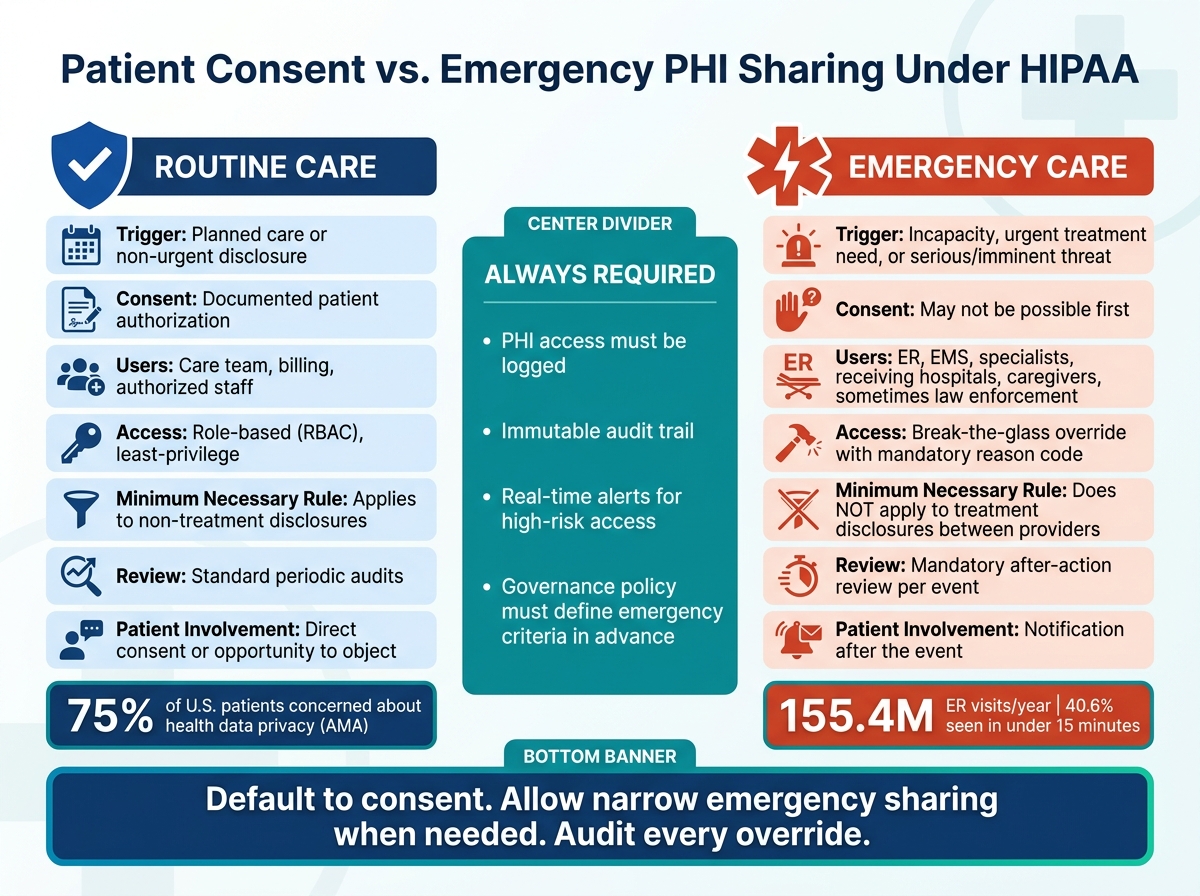
Patient Consent vs. Emergency PHI Sharing: HIPAA Rules at a Glance
Patient consent as the default model for PHI access
Outside emergencies, healthcare usually runs on consent-first workflows. HIPAA does allow PHI use for treatment, payment, and healthcare operations without written authorization. Even so, many organizations still record patient preferences so they can track sharing choices and protect trust. In practice, that means consent records function as part of access control, not as paperwork sitting in a folder.
That matters because patient concern is high. One AMA survey found that nearly 75% of U.S. patients were concerned about the privacy of their personal health information, and more than 92% said health data should not be sold.[14][15] When people feel uneasy about how their data is handled, care can suffer.
Routine disclosure rules, documentation, and patient choice
During registration, patients usually receive a Notice of Privacy Practices that explains how their PHI may be used for treatment, billing, and internal operations. Staff walk through it in plain English, and the patient signs an acknowledgment. The EHR then logs the date, the staff member, and the form type.[7][8]
Family and caregiver disclosures follow a similar pattern. HIPAA allows sharing relevant PHI when the patient agrees, does not object after having a chance to object, or clearly implies agreement.[4][5][6] Staff record approved contacts and refusals in the chart or through EHR flags. Refusals get the same careful treatment, which creates a traceable record that the organization followed the patient's wishes.[8][12] Those records matter because emergency workflows may need to bypass them for a short time.
How privacy-by-design supports consent-based access
On the technical side, consent-based access depends on least-privilege rules and role-based access control (RBAC). RBAC limits what people can see based on their job. Front-desk staff see scheduling details, billing staff see claims data, and clinicians see clinical records.[11]
These controls work best in predictable, non-urgent workflows. Access is tied to job duties during onboarding, and higher permissions need supervisor approval. If someone's role changes or employment ends, access is changed or removed. Periodic reviews compare assigned roles with actual job duties and strip out rights that are no longer used.[9][11]
Identity management adds another layer. Systems use unique user IDs, multi-factor authentication, and audit logs so each PHI access event is tied to a specific person in a specific role.
The problem shows up when a patient is unconscious or unstable. The same controls that limit unnecessary PHI exposure during routine care can also slow access when every minute counts.[9][10][11] In urgent care, the default model starts to bend, and narrower emergency disclosure rules take over.
sbb-itb-535baee
Emergency data sharing: when consent is not required first
When a patient can't consent and care can't wait, HIPAA allows limited PHI sharing without prior authorization. In an emergency, the key change is timing and scope - not the duty to protect PHI.[1] The main paths here are treatment, best-interest disclosure, and serious-threat disclosure.
HIPAA treatment exceptions, best-interest disclosures, and serious-threat disclosure
HIPAA's treatment exception lets covered entities share PHI for treatment without prior authorization. That includes sharing with ED physicians, trauma teams, on-call specialists, and EMS crews involved in the patient's care.[1]
If a patient is incapacitated and can't give meaningful consent, clinicians may share PHI with family, friends, or caregivers involved in care or payment when, in their professional judgment, that sharing is in the patient's best interest.[21][22] The disclosure should stay limited to what that person needs to help with care or payment. If the patient later regains capacity, the care team should reassess the patient's own wishes about information sharing.
There's also the serious-threat rule. If a provider believes a patient poses a serious and imminent threat to the health or safety of the patient or others, PHI may be shared with people who can reasonably prevent or lessen the harm. That can include family members, caregivers, security personnel, or law enforcement.[17][20][23] The provider should act in good faith and share only what is needed to reduce the threat.
Minimum necessary: when it applies and when treatment is different
The next limit is scope. The minimum necessary standard applies to most non-treatment disclosures, such as billing, quality reporting, or payer requests. But HIPAA explicitly does not apply that rule to treatment disclosures between providers.[16][18]
So if an ED physician is consulting a cardiologist on an unstable patient, the physician can share the full relevant record - labs, imaging, medication history, problem lists, and prior notes - without removing clinically relevant detail. Urgent care shouldn't be slowed down by extra permission steps.[19]
That said, the line still matters. Use treatment pathways for care. Use minimum-necessary limits for non-treatment disclosures.
Comparison table: Consent-first sharing vs. emergency disclosure
These rules look most different when you compare why the data is shared and how much detail can be disclosed.
| Factor | Consent-first sharing | Emergency disclosure |
|---|---|---|
| Trigger condition | Routine care, planned disclosure, or non-urgent sharing | Incapacity, urgent treatment need, or serious/imminent threat |
| Legal basis | Patient authorization or routine HIPAA permission | Treatment exception, best-interest disclosure, or serious-threat allowance |
| Typical users | Usual care teams, authorized staff, billing and operations personnel | Treating clinicians, receiving facilities, EMS, caregivers, security, and sometimes law enforcement |
| Speed of access | Slower, permission-based | Immediate when delay would interfere with care |
| Documentation | Authorization or routine disclosure record | Professional judgment rationale and reason for access |
| Patient involvement | Direct consent or opportunity to object | May be unavailable; disclosure can proceed without prior consent in limited circumstances |
| Minimum necessary | Applies to most non-treatment disclosures | Does not apply to treatment disclosures between providers |
| Privacy risk | Lower when properly limited | Higher; access should still be tightly scoped and reviewed |
Cybersecurity controls for emergency access and break-the-glass events
Legal exceptions set the rules for when PHI can be shared without consent. Technical controls decide how that access happens, how long it lasts, and how it gets tracked. At this point, the main issue isn’t whether emergency sharing is allowed. It’s how to measure what matters for cybersecurity to keep it tight and accountable.
How break-the-glass access should work
Break-the-glass (BTG) is an emergency override that lets a user bypass normal access limits during a real emergency. It should never happen silently. BTG must require a direct user action and a reason code before access is granted[35][27]. At the moment of activation, the system should record the user’s identity, the patient, the time, the reason, and the records opened.
Once BTG is turned on, access should be time-limited and narrow in scope. A sound workflow gives read access to data that matters most in care - problem lists, allergies, medications, recent labs, and imaging - while blocking higher-risk actions like bulk export, printing, or mass download[3][27][29]. Sessions should stay short. If the user needs more time, they should have to justify it again.
The warning prompt matters more than it may seem. In one study of 5,608 unauthorized access attempts, 45% stopped because users gave up after seeing the BTG warning[34].
That tells you something important: BTG isn’t just an access-control issue. It’s also a workflow issue.
Logging, alerts, post-event review, and patient notification
Each BTG event should create an immutable audit log entry that end users and local administrators cannot change[2][24][25][26]. NIST SP 800-66r2 also says audit trail data and log-review frequency should be set based on the organization’s risk assessment[32][33].
Real-time alerts matter too. Privacy and security teams should get immediate notice when a BTG event happens, especially in higher-risk cases such as access to a sensitive or high-risk record, repeated BTG use by the same person, or emergency access outside normal clinical hours[25][28][31]. At the same time, nobody wants a flood of noise. One practical setup is to send all BTG events into a review queue, escalate only the highest-risk cases, and roll routine, clearly justified events into periodic reports[28][30].
After the event, there should be a mandatory after-action review without delay[36][37]. That review should confirm the clinical reason, check that access stayed within the right scope, and flag anything that doesn’t line up with the stated reason. The patient or representative should also be notified after the event, especially when sensitive records are involved[24][26].
The hard part is ownership. Someone has to review these events, someone has to escalate exceptions, and someone has to track patterns over time. Without clear governance, even a well-built BTG control can fall apart in practice. This highlights the need for creating a culture of cybersecurity that prioritizes patient safety alongside technical compliance.
Comparison table: Standard consent-based access vs. emergency break-the-glass access
| Factor | Standard consent-based access | Emergency break-the-glass access |
|---|---|---|
| Trigger | Routine job responsibilities or patient authorization | Clinician-initiated urgent override for an emergency need |
| Access scope | Role-based, minimum necessary where applicable | Temporarily elevated read access; high-risk actions restricted |
| Approval flow | Pre-approved during onboarding or by policy | Self-triggered with mandatory reason capture at activation |
| Audit depth | Standard system logging | Immutable audit trail capturing user, patient, timestamp, and reason |
| Alerting | Periodic or routine log review | Real-time alerts to privacy and security teams |
| Review requirements | Quarterly or periodic access reviews | Mandatory after-action review of each event |
| Patient awareness | Governed by standard Notice of Privacy Practices | Notification to the patient or representative once the event is over |
| Misuse risk | Lower; primary risk is permission creep | Higher; emergency override can be exploited without strong controls |
Balancing patient autonomy, safety, and risk oversight
Once break-the-glass controls are set, governance decides when people can use them and who checks what happened after the fact. The goal is simple: make consent the default, spell out emergency access ahead of time, and keep a reviewable audit trail for every override.
Governance steps for HDOs and vendor-connected systems
Start with clear policy. Governance teams - privacy officers, compliance leads, clinical leaders, and IT security - should agree on what counts as an emergency before one happens. That usually means incapacity, immediate risk of serious harm, or a declared mass-casualty or disaster event. Those rules should live in policy, show up in workflows, and connect to required documentation fields like reason codes and free-text justification. If the definition is fuzzy, emergency access gets used unevenly.[13]
Policy alone isn't enough. Staff need to know not just when emergency access is allowed, but also that this access is limited and subject to review. Downtime and surge drills should test two things: can clinicians get the data they need when main systems are down, and do backup workflows still protect PHI while keeping audit records intact? That turns emergency access into a practiced workflow instead of a loose carveout.[3][38]
Vendor oversight is another pain point. Any third-party system that handles PHI should meet the same emergency-access, logging, and audit rules as the EHR. Business associate agreements should clearly require vendors to support:
- unique user authentication
- emergency access logging
- after-the-fact audit access
Governance reviews should pull logs from those outside systems along with internal logs. When possible, teams should bring them into one central monitoring and risk-management view.[25][38]
Where Censinet fits into emergency data-sharing risk oversight
Central oversight gets harder fast when PHI moves across many vendors and clinical systems. Censinet RiskOps™ gives HDOs one place to review third-party risk, emergency-access controls, and audit logging across systems that handle PHI. Its automated workflows and risk views help governance teams track vendor risk across medical devices, supply chains, and clinical applications, so gaps don't sit in the dark until an incident exposes them.
Conclusion: Default to consent, prepare for exceptions, audit every emergency access event
Three commitments keep this approach on track. Default to consent: outside a documented emergency, PHI access should follow authorization rules, role-based limits, and least-privilege access. Prepare for exceptions: document emergency criteria, build BTG workflows into your systems, train staff, and run drills so emergency access is deliberate, time-limited, and tied to a stated reason. Audit every event: log who accessed what, when, why, and from where; protect those logs; send alerts for high-risk access; review them fast; and watch for patterns over time.[39][27][25]
Treat break-the-glass as an audited exception. That is how privacy and fast care can work side by side.
FAQs
Can a hospital share my PHI with family in an emergency?
Yes. In an emergency, hospitals may share PHI with family, friends, or other people involved in your care when doing so is in your best interest.
Under HIPAA, providers rely on good-faith professional judgment. They usually keep any disclosure narrow and stick to what you would likely permit, such as your name, location, condition, or status.
If you are incapacitated, they share only the information needed to support your care or notify the people responsible for your well-being.
Who reviews break-the-glass access after an emergency ends?
After an emergency ends, privacy, security, or clinical leadership teams should review what happened. Their job is to confirm that the override was medically justified, spot any access that went beyond what was needed, and see whether repeated patterns suggest gaps in policy or staff training.
Censinet RiskOps™ helps manage this step by sending emergency access reports to authorized reviewers, which supports steady oversight and clear documentation.
What happens if emergency PHI access is misused?
Misuse of emergency Protected Health Information (PHI) access, such as unauthorized "break-glass" events, is usually treated as a breach. The only way around that presumption is for the organization to document a four-factor risk assessment that shows there was a low probability the PHI was compromised.
If the organization can't do that, it must notify affected individuals and the HHS Secretary without unreasonable delay and no later than 60 days after discovery. On top of that, this kind of misuse can lead to regulatory penalties, legal challenges, and a loss of patient trust.
