
If you handle PHI in the cloud, NIST is the best starting point for most healthcare vendors. The reason is simple: you need a framework that helps you contain the incident, keep care-related systems available, and document every step for HIPAA and HITECH review.
In this article, I compare five frameworks: NIST, SANS, ISO/IEC 27035, HITRUST CSF, and CIS Controls. I look at them using four tests that matter in healthcare cloud work:
- HIPAA/HITECH fit
- Cloud response steps
- Forensics and records
- Third-party vendor security risks and coordination
A recent case shows why this matters. In February 2024, the Change Healthcare ransomware attack led to the shutdown of more than 100 systems and an $872 million hit in Q1 2024. For a healthcare cloud vendor, that kind of event can disrupt claims, pharmacy access, and patient care fast. These events highlight the growing risks to patient care from clinical application downtime.
Here’s the short take:
- NIST SP 800-61: best base for most U.S. healthcare cloud vendors
- SANS PICERL: best for hands-on response teams that need clear step-by-step action
- ISO/IEC 27035: best for governance, leadership oversight, and multi-party coordination
- HITRUST CSF: best when healthcare buyers want mapped controls and certification evidence
- CIS Controls: best for smaller teams that want a plain, technical baseline
The main takeaway: no framework solves the contract problem by itself. You still need BAAs, SLAs, clear notice rules, evidence handling steps, and shared-responsibility runbooks.

Incident Response Frameworks for Healthcare Cloud Vendors: Side-by-Side Comparison
Improving Healthcare Incident Response in the Wake of Recent Healthcare Breaches
sbb-itb-535baee
Quick Comparison
| Framework | HIPAA/HITECH fit | Cloud response fit | Forensics and records | Third-party risk management | Best for |
|---|---|---|---|---|---|
| NIST SP 800-61 | High | High | High | High | U.S. healthcare cloud vendors needing a strong base |
| SANS PICERL | Medium | Medium | High | Medium | SOC and IR teams focused on execution |
| ISO/IEC 27035 | Medium | Medium | Medium | High | Governance-heavy and multi-jurisdiction vendors |
| HITRUST CSF | High | High | High | High | Vendors selling into healthcare procurement teams |
| CIS Controls | Medium | Medium | Medium | Medium | Small-to-mid-sized vendors building a baseline |
If you want the short answer, it’s this: pick one main framework, map it to HIPAA, define who owns what in the cloud, and prebuild your notice and evidence process before an incident happens.
1. NIST Incident Response Guidance
NIST SP 800-61 ("Computer Security Incident Handling Guide") is the starting point for cloud incident response [1]. It lays out four core phases: Preparation; Detection and Analysis; Containment, Eradication, and Recovery; and Post-Incident Activity [2].
That lifecycle gives healthcare cloud vendors a clear structure. But they can't copy and paste it as-is. In a cloud setting, and especially in environments packed with PHI, teams need to adjust it to fit shared responsibility, HIPAA duties, PHI handling, and vendor coordination.
Healthcare Regulatory Alignment
In healthcare, incident response has to line up with HIPAA and HITECH through the shared responsibility model. A common way to do that is to use NIST SP 800-53 IR controls, with extra attention on IR-4, IR-5, IR-6, and IR-8, to shape procedures and notification workflows [1].
HITECH also sets a clear bar here. Before an organization decides that breach notification isn't needed, it must complete a low-probability-of-compromise analysis [3]. That means response plans should already spell out:
- Notification contacts
- Pre-approved communication templates
- Which compliance staff can notify the HHS Office for Civil Rights
On paper, that sounds straightforward. In practice, it only works if the plan fits cloud tools and cloud-native containment steps.
Cloud Response Coverage
Cloud incident plans need to deal with shared responsibility, API-based evidence collection, and coordination with the cloud provider. If a PHI-processing system is hit, teams should be ready to isolate affected resources fast by using VM snapshots, flow logs, and API-driven quarantine [1] [2].
Cloud tagging and naming rules matter too. If PHI-bearing assets are clearly labeled, responders can sort out what needs attention first based on data sensitivity [1].
Forensics and Documentation Support
NIST requires teams to preserve evidence without altering it. In cloud environments, that usually means taking disk and memory snapshots and storing them in immutable storage, such as Azure Storage or Amazon S3, so forensic artifacts stay unchanged for legal or regulatory review [1] [2].
Key sources for an investigation include:
- Identity and Access logs (Azure AD/IAM)
- VPC Flow Logs
- System snapshots
Those records help teams piece together what happened, when it happened, and what data or systems were touched [1].
Post-incident work matters just as much. Teams should document lessons learned and keep evidence for later audits and exercises [1] [2]. That same level of discipline should also cover healthcare vendor breach response best practices, escalation paths, and contract terms.
Governance and Third-Party Coordination
BAAs and SLAs should spell out provider notification timing, escalation paths, and the support expected during incident handling [3] [4]. Incident contacts should also be stored in cloud alerting tools so notices reach the right people without delay [1].
One point can't be missed: even if provider infrastructure plays a role in the incident, the healthcare organization still carries responsibility for breach notification [3].
NIST sets the base. The next framework goes deeper into process and day-to-day operations.
2. SANS Incident Handling Process
Where NIST lays out the lifecycle, SANS gets more hands-on with the day-to-day response cycle. The SANS incident handling process uses the PICERL model: Preparation, Identification, Containment, Eradication, Recovery, and Lessons Learned [5][7][9].
In plain English, it gives responders a repeatable way to move fast without making a mess. Teams often use it alongside NIST or ISO. That’s a good fit for healthcare cloud vendors, where you may need to preserve evidence while keeping clinical systems up and running. In cloud settings, that matters a lot because speed and documentation have to work side by side.
Healthcare Regulatory Alignment
SANS turns HIPAA response duties into concrete steps through PICERL. Identification helps teams figure out whether PHI was exposed. Containment helps stop more access. Lessons Learned feeds updates into policy and staff training. And if OCR reviews a breach report later, your documented decisions and timelines can make or break the process [12].
Cloud Response Coverage
SANS is cloud-neutral, which means it doesn’t tell you which cloud-native controls to use. That leaves some work to the team. For healthcare cloud vendors, the Identification and Containment phases should include cloud-focused runbooks for things like:
Those steps aren’t outside the model. They’re just the practical layer that makes PICERL work in cloud environments.
Forensics and Documentation Support
SANS puts strong focus on evidence preservation, chain of custody, and incident timelines [10][11]. In a healthcare cloud setting, that usually means keeping a written incident-handler checklist for each phase. The team should record which PHI, ePHI, or clinical systems were affected, along with each response decision.
That record helps with root-cause analysis, regulatory reporting, and any legal review that follows a confirmed breach.
Governance and Third-Party Coordination
Healthcare cloud incidents almost never stay inside one team. Cloud providers, MSSPs, SaaS vendors, and downstream business associates may all be involved.
That’s why roles need to be set before anything goes wrong. Define who can approve containment, who owns external communications, and how evidence requests move across vendors, MSSPs, and third-party business associates. Contracts and BAAs should also spell out incident notification terms and shared communication channels, so response work doesn’t stall at the worst possible moment.
That kind of execution discipline leads naturally into ISO/IEC 27035, which turns incident response into a formal management system.
3. ISO/IEC 27035
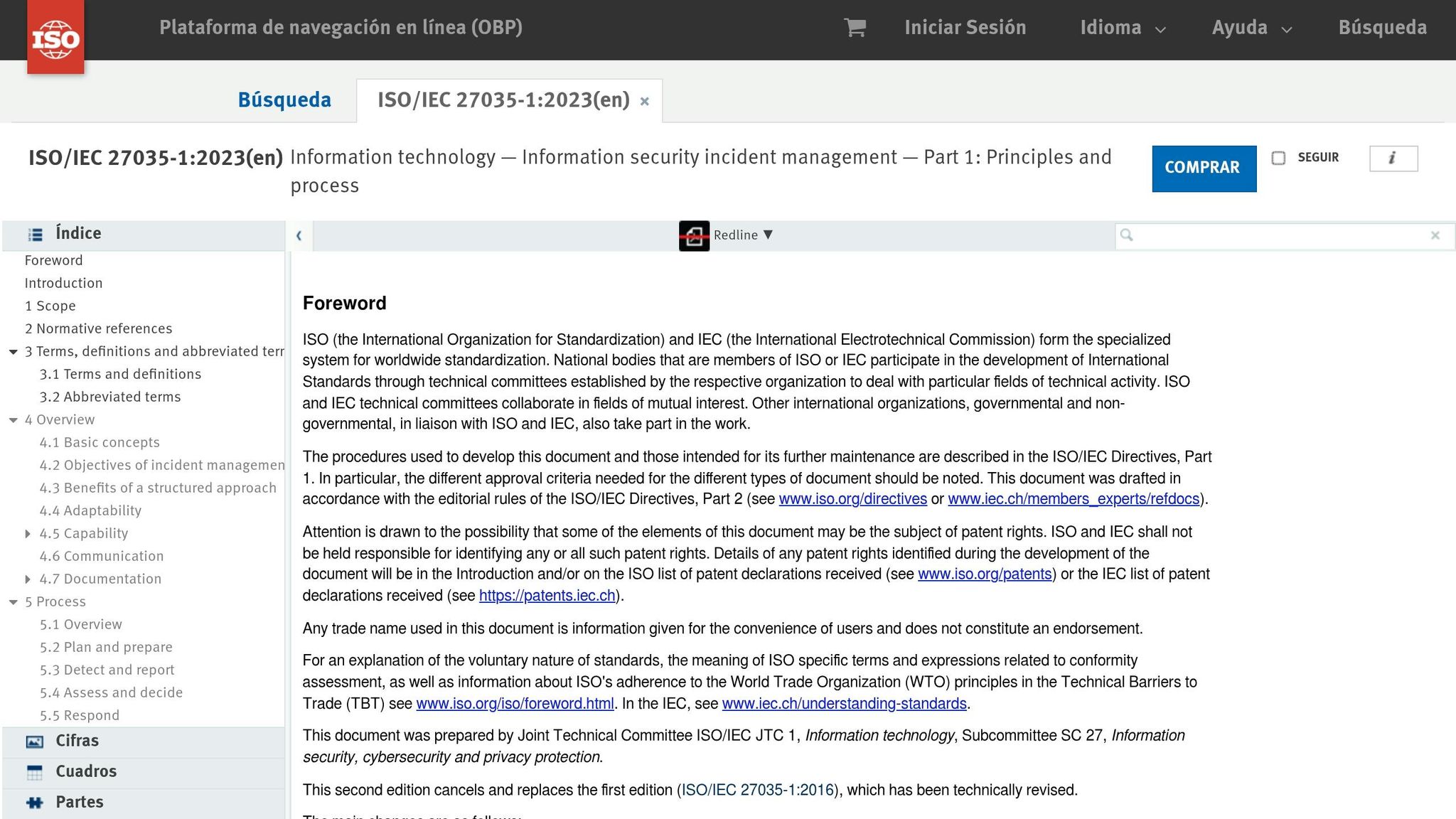
ISO/IEC 27035 takes a governance-focused approach to incident management. Instead of jumping straight into tooling or technical steps, it puts a lot of weight on preparation, oversight, and lessons learned [13]. ISO/IEC 27035-2:2023 was published in February 2023 and is generic by design, which means cloud vendors that handle PHI can apply it without the standard being tied to one sector or one setup [13]. For healthcare cloud vendors, that matters when incident response needs formal coordination, clear documentation, and executive oversight.
Healthcare Regulatory Alignment
The standard does not name HIPAA. Still, its focus on internal and external coordination lines up well with BAA-driven incident workflows for healthcare cloud vendors. In practice, it supports preplanned communication protocols and breach-notification timelines, including HIPAA's 60-day window [13].
That governance focus becomes more useful once teams turn it into day-to-day cloud operating procedures.
Cloud Response Coverage
ISO/IEC 27035-2:2023 explicitly applies to external organizations providing information security incident management services, which makes it directly relevant to cloud service providers [13]. In the "plan and prepare" phase, it calls for policy, executive commitment, an Incident Management Team (IMT), operational support, and policy updates across systems, services, and networks [13].
For healthcare cloud vendors, this gives them a clear starting point for working with HDOs during triage, notification, and recovery. It helps set expectations before pressure hits. At the same time, teams still need to tailor the guidance to their own cloud vs. on-premise risk environment [13].
Forensics and Documentation Support
The "learn lessons" phase helps with audit readiness by requiring a review of gaps, team performance, and the incident management plan [13]. That kind of review supports the continuous improvement expectations often seen in healthcare compliance audits.
Governance and Third-Party Coordination
ISO/IEC 27035 also requires top management commitment, which puts incident response under executive governance [13]. That matters for healthcare cloud vendors because incidents rarely stay inside one team. Security, legal, compliance, customer success, infrastructure, and client-side contacts may all need to move in sync.
The standard's focus on an IMT and formal coordination with external organizations helps make vendor-client coordination more concrete before a cloud incident happens , often facilitated by automated vendor risk assessment solutions [13]. That's the main healthcare-specific value here. A RACI matrix can help spell out who owns each step across the incident lifecycle.
Its main strength is structure; the next framework turns that structure into healthcare-specific controls.
4. HITRUST CSF Incident Management Controls
HITRUST CSF is a certifiable framework used across U.S. healthcare. It pulls together HIPAA, HITECH, NIST, ISO, and other sources into one framework that organizations can certify against. For cloud vendors selling into healthcare, that can cut down on repeat audits and the same security questionnaires showing up again and again. That edge matters most when vendors need to show steady response controls across many healthcare customers.
Healthcare Regulatory Alignment
HITRUST CSF Domain 11, Information Security Incident Management, maps directly to HIPAA Security Rule requirements under §164.308(a). HITRUST CSF v11, released in 2023, simplified the incident management domain and tightened alignment with the NIST Cybersecurity Framework’s “Respond” and “Recover” functions. The practical question, then, is how that compliance mapping shows up in day-to-day cloud work.
Cloud Response Coverage
HITRUST uses a Shared Responsibility Matrix for cloud environments. Vendors spell out which incident response tasks sit with the cloud service provider and which sit with the vendor. HITRUST’s Inheritance feature can also cut audit work by pulling in existing CSP security certifications. You can see the cloud model most clearly in how HITRUST assigns response ownership across each phase of an incident.
| IR Phase | HITRUST CSF Requirement | Cloud Vendor Responsibility |
|---|---|---|
| Detection | 11.01: Reporting Security Events | Ensuring employees and contractors report suspected security events |
| Assessment | 11.02: Reporting Security Weaknesses | Assessing whether the issue affects PHI and requires escalation |
| Containment | 11.03: Management of Information Security Incidents and Improvements | Executing response procedures quickly and consistently |
| Forensics | 11.03: Collection of Evidence | Preserving logs and snapshots while maintaining chain of custody |
| Improvement | 11.03: Learning from Information Security Incidents | Using lessons learned to update controls and response plans |
Those mappings aren’t just paperwork. HITRUST also expects teams to preserve evidence and document response decisions as the incident unfolds.
Forensics and Documentation Support
Control 11.03 requires formal evidence handling. In cloud environments, vendors should use automated logging and WORM storage to protect evidence integrity for legal and regulatory review. That matters because if logs, snapshots, or timelines can’t be trusted later, the whole review process gets shaky fast.
Governance and Third-Party Coordination
HITRUST requires an Incident Response Team (IRT) with defined roles and executive oversight. It also expects pre-set communication channels for notifying security, legal, compliance, customer contacts, regulators like the HHS Office for Civil Rights (OCR), and subprocessors. In practice, that means teams shouldn’t be writing notices from scratch in the middle of an incident.
Prebuilt notification templates can help a lot here, especially when they satisfy both HITRUST requirements and HIPAA’s 60-day breach notification window. When the clock is ticking, that prep work can save hard-earned time.
HITRUST’s main advantage is its prescriptive control mapping, which helps when vendors need the same incident-handling approach across many healthcare clients. The tradeoff is pretty clear: that structure is strong for control mapping, but less flexible than lighter-weight models.
5. CIS Controls for Incident Response
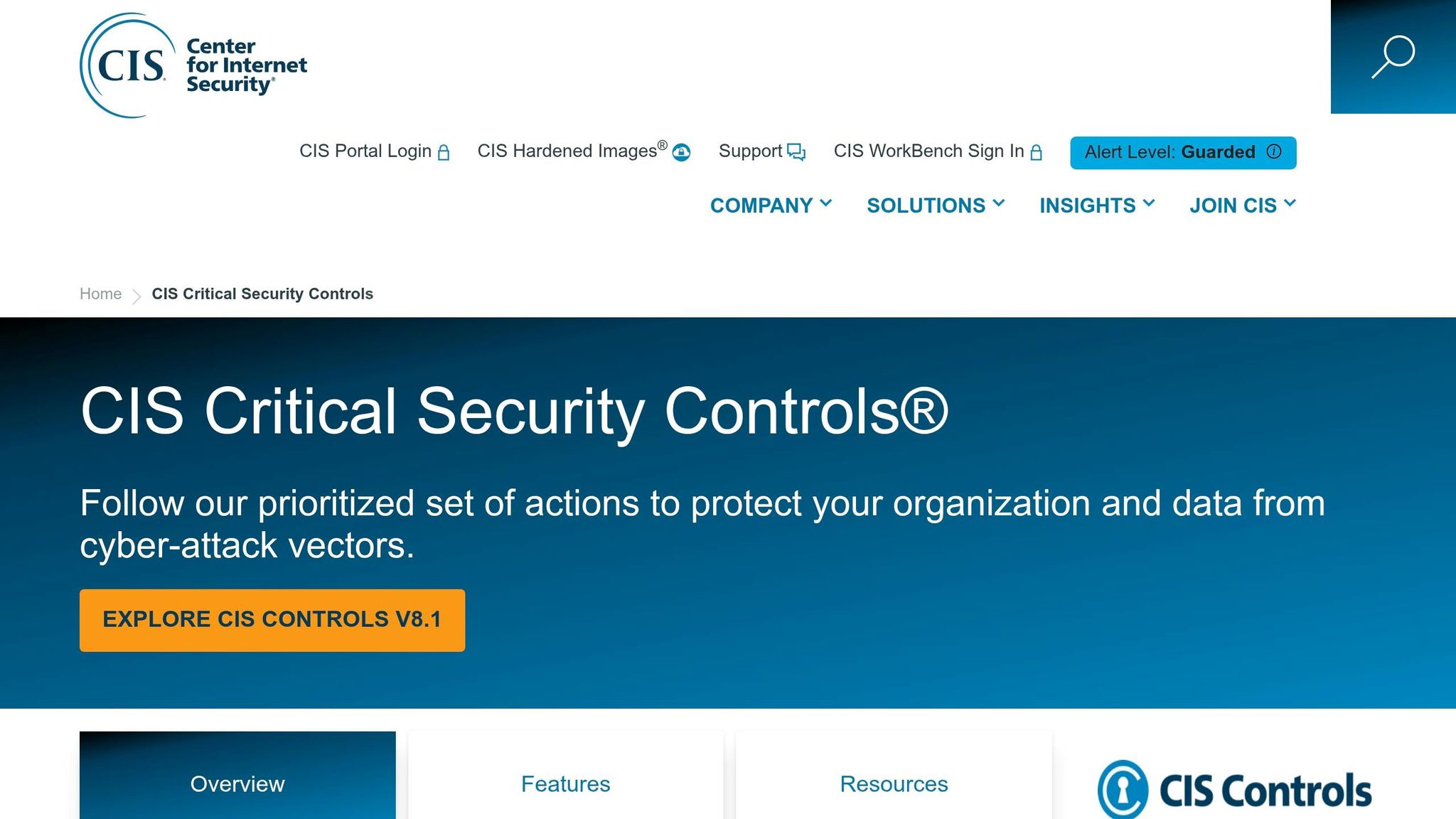
Where HITRUST leans toward certifiable control mapping, CIS puts the spotlight on day-to-day incident response work. CIS Controls v8.1 take a more hands-on, control-led approach than the frameworks covered earlier. For healthcare cloud vendors, Control 17 (Incident Response Management) - sub-controls 17.1 through 17.9 - is the main incident response set.
Healthcare Regulatory Alignment
CIS Controls v8.1 give teams a baseline for HIPAA incident procedures. Sub-controls 17.3 (Incident Response Plan) and 17.5 (Communication Plan) matter most for HIPAA-aligned notification workflows. The focus is simple: documented procedures, tested plans, and clear communication steps.
Cloud Response Coverage
CIS 17.1, 17.2, and 17.3 center on preparation. In cloud settings, that means adjusting 17.1–17.3 to fit shared-responsibility boundaries [2]. Put plainly, vendors need to spell out which incident response tasks they own and which belong to the cloud service provider (CSP). That includes access revocation, stakeholder alerts, provider handoffs, and evidence export.
| CIS Control (v8.1) | IR Pillar | Healthcare Cloud Application |
|---|---|---|
| 17.1, 17.2, 17.3 | Preparation & Detection | Tailoring IR plans to the shared responsibility model and cloud-native investigation tools [2] |
| 17.4, 17.5 | Notification & Coordination | Automating stakeholder alerts to meet HIPAA 60-day notification mandates [2] |
| Mapping to NIST | Framework Alignment | CIS Controls map to NIST SP 800-53 (IR-1, IR-2, IR-4) and ISO 27001:2022 (A.5.24) [2] |
Those same procedures also need to preserve evidence for later review.
Forensics and Documentation Support
CIS 17.8 (Post-Incident Activity) supports evidence retention through immutable cloud storage, including write-once-read-many (WORM) storage, VM snapshots, memory dumps, network flow logs, and API-based log exports. The goal is to protect log integrity for legal and regulatory review [1][2].
"Cloud customers must understand the content and format of data that the cloud provider will supply for analysis purposes and evaluate whether the available forensics data satisfies legal chain of custody requirements." - Cloud Security Alliance [4]
Governance and Third-Party Coordination
CIS 17.4 and 17.5 call for defined contacts across legal, compliance, and leadership, along with verified 24/7 security contacts at the CSP [2]. Vendors should set up those contact paths and test them on a regular basis before anything goes wrong. SLAs with each CSP should also clearly guarantee support across every incident handling stage: detection, containment, eradication, and recovery [4].
That’s where CIS becomes especially useful. It stays close to the work teams have to do when an incident hits, even if it leaves a few gaps the next section takes up.
Pros and Cons of Each Framework in Healthcare Cloud Environments
No single framework works for every healthcare cloud vendor. Each one gives you a different mix of depth, cost, speed, and healthcare-specific guidance. And that matters a lot once you move from theory to day-to-day response.
Here’s the short version:
| Framework | Major Strengths | Main Limitations | Best-Fit Use Case | Scenario |
|---|---|---|---|---|
| NIST SP 800-61 | Comprehensive lifecycle; strong audit trail | Resource-intensive; requires significant customization for healthcare workflows | Large or complex multi-cloud vendors | Cloud forensic preservation |
| SANS (PICERL) | Operations-first response | Less detailed on HIPAA notification and contract terms | Technical SOC teams who need speed | Fast ransomware containment |
| ISO/IEC 27035 | Best for global governance alignment | Costly and requires extensive documentation | Global vendors across multiple jurisdictions | Cross-border coordination |
| HITRUST CSF | Best healthcare-specific control mapping | Costly and slow to certify; high evidence burden | Vendors handling high volumes of ePHI or critical clinical data | Healthcare procurement due diligence |
| CIS Controls | Best for prioritized technical execution | Lacks the policy and risk management depth of NIST or ISO | Small-to-mid-sized vendors focused on technical security hygiene | Baseline alerting and logging |
The biggest gap shows up when these frameworks have to turn into contract terms and clear lines of responsibility. All five still rely on BAAs to spell out notification, liability, and escalation. HITRUST gets closer than the others, but it still doesn’t replace that contract layer.
Cloud containment is another place where the differences become obvious. NIST SP 800-61 is the strongest choice when a team needs precise isolation and clean forensic handling. SANS (PICERL) moves faster, which is great in a ransomware event, but it can also lead teams to contain too broadly if they don’t know cloud systems well.
For organizations managing third-party vendor risk in healthcare to judge vendor maturity, standardized third-party risk assessment questions make these differences easier to act on during procurement. For HDOs comparing vendors, Censinet RiskOps™ standardizes third-party assessments and evidence reviews against these framework requirements.
Conclusion
When you line everything up, one point stands out: for U.S. healthcare cloud vendors, NIST SP 800-61 is still the clearest starting point. It fits cleanly with HIPAA/HITECH and lines up well with how cloud incidents play out in practice. In healthcare cloud settings, incident response has to juggle three things at once: containment, PHI protection, and documentation that can stand up to review. NIST offers the most direct path to all three.
The best move is to use one main framework, map it to HIPAA/HITECH, and shape it around IaaS, PaaS, and SaaS incident workflows, with extra care around evidence collection and provider coordination. In plain terms, that means turning the framework into cloud-specific runbooks, evidence handling steps, and BAA-aligned notification procedures, not treating it like a box-checking exercise.
For HDOs that are reviewing vendors, Censinet RiskOps™ helps standardize evidence collection and review for PHI-focused assessments. At the end of the day, the question isn’t whether a vendor can point to a framework on paper. It’s whether they can carry it out when the pressure is on.
FAQs
How do I choose the right framework for my cloud environment?
Align your strategy with established standards like the NIST Cybersecurity Framework or HHS 405(d) HPH Cybersecurity Performance Goals. Those frameworks give you a clear way to shape governance and incident response, instead of building the playbook from scratch.
Next, weigh that choice against your cloud provider and your organization’s top priorities. Censinet RiskOps can help speed up risk assessments and support a framework that covers patient data and clinical applications.
Can one framework cover both HIPAA compliance and cloud incident response?
Yes - if the framework can link HIPAA compliance to day-to-day security work.
HIPAA sets the legal baseline for protecting patient data. But it doesn’t spell out the technical steps teams should take when incidents happen. That’s where frameworks like the NIST Cybersecurity Framework or HITRUST CSF come in.
They can map HIPAA requirements into a broader, measurable security plan, often through crosswalks that line up operational work with audit needs.
What should be included in a BAA or SLA for incident response?
BAAs and SLAs should spell out who does what when something goes wrong.
That starts with breach notification. Set a breach notification SLA of 24 to 72 hours. Also define how evidence will be shared, when fourth-party risk must be disclosed, and whether you can suspend access during an incident.
Just as important, assign ownership for service restoration. If a breach happens, there shouldn't be any guesswork about who handles detection, triage, containment, forensic investigation, and regulatory reporting.
A simple RACI matrix can help map this out:
- Responsible: Who does the work
- Accountable: Who owns the outcome
- Consulted: Who gives input
- Informed: Who needs updates
